
“CGF” sounds like the name of one molecule, but commercial chlorella growth factor CGF is better treated as a supplier-defined chlorella-derived fraction. Extraction method, source species, dry solids and the assay used to report “CGF” can differ. A buyer who copies a number from one brochure into another supplier’s specification may compare unlike materials. This guide shows how to ask for a usable identity, build a testable purchase specification and keep cell-culture observations separate from human health claims.
An original study of Chlorella vulgaris aqueous extract characterized a preparation called CGF and used it in laboratory cell-culture experiments; it did not establish a consumer health effect from ordinary food servings.
Contents
- What does CGF mean on a specification?
- How does an extract differ from whole chlorella?
- Which assays define the purchased grade?
- What can a 260-nanometer result show?
- How should composition be documented?
- Which claims require stronger evidence?
- What safety and quality gates apply?
- How should two suppliers be compared?
- What belongs in the commercial agreement?
- When should a brand skip CGF language?
1. What does CGF mean on a specification?
Convert a trade term into a material definition
Ask whether CGF means a hot-water extract, an enzyme-assisted fraction, a dried extract standardized by ultraviolet absorbance, or merely a marketing term for whole chlorella powder. Specify source species, cultivated biomass, cell disruption, extraction solvent, filtration, concentration, drying method and any carrier. If the material is whole chlorella, the specification should say so plainly. A supplier may use “CGF-rich” without proving that its powder is equivalent to a purified extract. The term should never be the only identity line on a purchase order.
An original 2020 extraction study used water-extracted C. vulgaris components and characterized the resulting preparation. A separate 2023 cell-culture study compared different commercial algal extracts called CGF and CVE. Their use of the term in laboratory contexts illustrates why buyers need the exact extraction and analytical method rather than one umbrella name. Request a representative certificate of analysis and a manufacturing flow diagram.
Agree on a product code that cannot be confused with the supplier’s broken-cell biomass powder or another soluble extract.

2. How does an extract differ from whole chlorella?
Compare what each process retains
Whole chlorella powder contains cell material and its associated proteins, lipids, carbohydrates and pigments. A water-soluble extract removes some insoluble matter and concentrates what the process carries into the liquid phase. Consequently, the two materials may differ in color, flavor, texture, nutrient profile and functional behavior. A broken-cell powder is still whole biomass unless a separation step removes components. The chlorella ingredient page describes biomass applications; that should not be read as a specification for a distinct CGF extract.
Ask the supplier for a mass balance: kilograms of starting dry biomass, extract solids recovered and final kilograms after carrier addition. This reveals whether a claimed concentration comes from genuine enrichment or from a different reporting basis. In a beverage, a soluble fraction may reduce visible particles, but “soluble” must be tested in the actual pH and process. In a tablet, a concentrated extract may change compression and hygroscopicity. If a brand wants to tell a whole-algae story, an extract is not an automatic substitute.
If it wants a specified soluble fraction, whole powder cannot be assumed equivalent simply because both originate from Chlorella.
| Attribute | Whole biomass | Defined aqueous extract |
|---|---|---|
| Material retained | Whole cell solids | Extracted soluble fraction |
| Particle behavior | Suspension and settling possible | Test solubility and haze |
| Composition basis | Biomass assays | Extract solids and carrier |
| Label story | Whole chlorella ingredient | Specific extract identity |
3. Which assays define the purchased grade?
Choose methods before negotiating a number
Many CGF specifications report an ultraviolet absorbance value at 260 nanometers. That can be a process marker, but the result is meaningful only with extraction solvent, dilution, path length, blank, dry-solids basis and calculation stated. Ask what “CGF units” mean and whether two labs can reproduce them. Add orthogonal measurements: dry solids, moisture, protein, nucleic-acid-related components if claimed, ash and any carrier percentage. HPLC or another compositional method may clarify what a broad UV marker cannot.
The analytical package should suit the actual grade and intended claim.
The 2020 original extract characterization reported UV absorbance and chemical analysis as separate measurements. That is a useful model: one signal should not stand in for complete identity. Request at least three recent commercial-lot certificates to see variability. A target with no defined method or tolerance cannot support lot release. Write the result units into the agreement and ask how out-of-range results are handled.
If the supplier changes extraction yield, enzyme or carrier, require advance notification because a stable UV value may conceal a meaningful composition change.

4. What can a 260-nanometer result show?
Interpret the signal within its limits
Absorbance near 260 nanometers is often associated with nucleic-acid-related material, but it is not a unique molecular fingerprint. Other compounds and sample preparation can influence the reading. The 2023 original cell-culture study observed large absorbance peaks near 260 nanometers in two algal extracts; the authors still treated the preparations as distinct samples. An OD value alone cannot tell a buyer the exact nucleotide mixture, peptide content, bioavailability or human effect.
It is best used as a tightly defined batch marker when its limitations are understood.
Ask the laboratory to report a dilution series and a blank to show the instrument operates in a suitable range. Confirm whether the stated value is per gram of extract solids, per gram of finished powder or per milliliter of solution. Those bases can produce very different-looking numbers. Include method repeatability and an acceptable range in the specification. If a supplier markets “highest CGF value,” request the actual comparative protocol before accepting a ranking.
A larger absorbance signal may reflect more UV-absorbing matter without proving superior performance in a food formula. Test the physical product in the intended application as well as in the assay cuvette.
| Assay detail | Ask the supplier | Why it matters |
|---|---|---|
| Wavelength | Exact setting and scan | Defines reported marker |
| Sample basis | As sold or dry solids | Enables comparison |
| Dilution | Solvent and factor | Prevents false ranking |
| Repeatability | Replicates and range | Supports release limits |
5. How should composition be documented?
Make the material legible to formulation and regulatory teams
Request a complete ingredient statement with carrier and processing-aid disclosures. Ask for total solids, moisture, ash, protein method and a compositional profile relevant to the claims the brand actually wants to make. If the supplier says “nucleotide-rich,” obtain a defined assay and lot range; if it says “peptide-rich,” ask what molecular-weight distribution or peptide method supports the term. Do not rely on an unlabeled chromatography graphic.
For a finished product, calculate the amount of the defined material per serving and record any losses during processing or storage.
The same extract may be sold in powder and liquid forms; compare them on dry-solids and functional-dose bases. A 20 percent-solids liquid is not equivalent by weight to a dry powder. Identify preservative and carrier contributions that affect label text, flavor and shelf life. Take retained samples from the lot used for the pilot. If a literature paper used another species, extraction process or concentration, cite it as context rather than proof about the purchased grade.
This approach leaves the product team with a reproducible ingredient identity and prevents a broad CGF slogan from masking formula-relevant differences.

6. Which claims require stronger evidence?
Separate laboratory observations from human outcomes
The name “growth factor” can suggest biological effects, but it is not itself proof that the material stimulates human growth, immunity, healing or metabolism. The cited 2020 and 2023 studies investigated cell-culture or laboratory systems. Such work can inform hypotheses and analytical methods, but it does not establish efficacy of a retail dose in people. A buyer should ask regulatory and legal reviewers to approve every consumer-facing statement for the intended market.
Avoid converting “supports cell growth in culture” into “promotes growth in consumers.” That leap changes both the subject and the evidence standard.
Safer copy can describe verifiable facts: source species, extraction method and measured composition, subject to truthful labeling rules. Even compositional wording needs testing and a stable range. For US dietary supplements, the FDA’s structure/function claim guidance explains distinct claim categories and responsibilities; it is not permission to infer an effect from a trade name. Keep a claims matrix that maps each sentence to a specific document and formula version.
If evidence is weak, improve the evidence or remove the claim. The purchasing team should not promise a marketing benefit in a contract that quality cannot measure.
| Proposed statement | Evidence needed | Better action if absent |
|---|---|---|
| “Contains CGF extract” | Defined identity and dose | Name actual extract |
| “Nucleotide-rich” | Valid assay and threshold | Omit descriptor |
| “Improves human health” | Relevant human evidence and legal review | Do not use |
| “Whole chlorella” | Whole-biomass identity | Do not use for extract |
7. What safety and quality gates apply?
Qualify the extract as a food ingredient
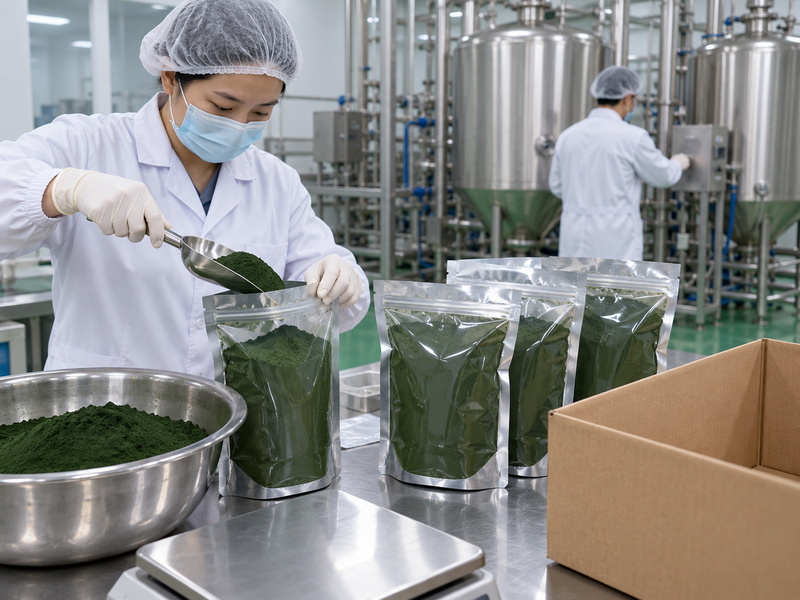
The source biomass, extraction water, equipment, drying and packaging all need controls suited to the intended market and use. Request a risk-based specification for microbiology, contaminants, residual processing materials where relevant, moisture, identity and traceability. For algal ingredients, ask how the supplier assesses source-water and toxin risks. Do not copy limits written for a different species or product form without reviewing applicability. A concentrated extract can also concentrate some unwanted constituents, so the finished material needs its own certificate rather than borrowing the biomass certificate.
Inspect a production flow chart and a representative lot certificate. Check whether the certificate names the exact extract grade, not generic chlorella powder. The FDA supply-chain guidance supports hazard-based verification for covered receiving facilities. In formulation, measure solubility, color drift, odor and water activity in the proposed package. If the extract is hygroscopic, a liner that works for whole powder may fail. Keep an incoming retain and a first-production retain to investigate later complaints.
Safety release and marketing-claim approval should be separate documented steps.
8. How should two suppliers be compared?
Compare equivalent material, not equivalent slogans
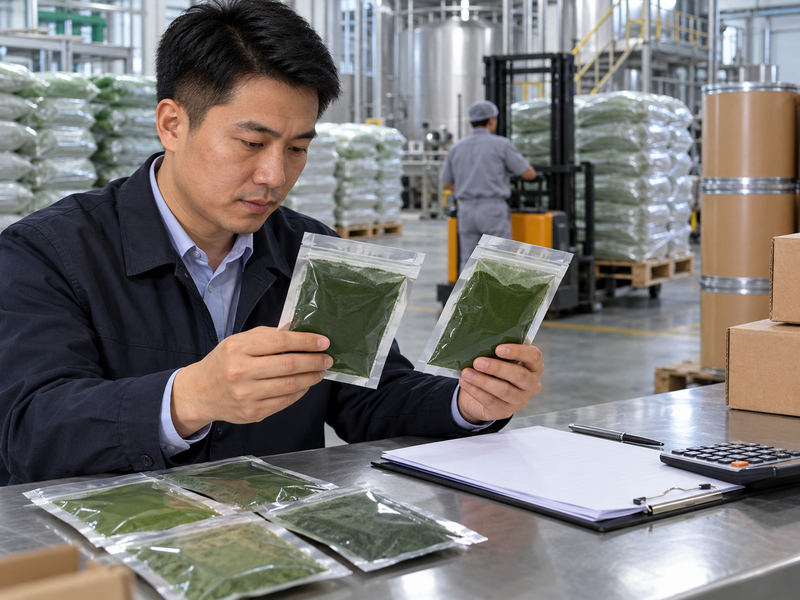
Send both suppliers the same request: species, process, extraction ratio, carrier, solids, A260 method, compositional assays, safety specification, packaging and intended application. Ask for normal commercial lots and current certificates. If the processes differ substantially, classify the products as alternatives rather than asserting they are the same grade. Run a bench trial at equal dry-extract solids, then at equal measured marker if the marker is relevant. Evaluate color, flavor, solubility and physical stability.
A higher marker value may demand a smaller dose, but the finished-product result still decides whether the substitution works.
Use a scoring sheet with hard gates for identity, legality and safety; score functional performance and cost only after those pass. Verify lead time and capacity. If one supplier offers a proprietary CGF number with no method, request the method before price negotiation. Ask the supplier contact team for a defined extract dossier if CGF is available, and distinguish it clearly from the standard chlorella biomass range. Document any differences that affect the finished label.
A side-by-side trial is useful only if the comparison basis is written down.
| Comparison gate | Supplier A | Supplier B |
|---|---|---|
| Exact material identity | Documented | Documented |
| A260 protocol | Reproducible | Reproducible |
| Safety certificate | Lot-linked | Lot-linked |
| Formula trial | Accepted or rejected | Accepted or rejected |
9. What belongs in the commercial agreement?
Protect the approved grade from silent change
Name the source organism, manufacturing site, extraction process category, carrier, product code, test methods and acceptable ranges. Include packaging, shelf life, storage instructions, retained-sample expectations and lot coding. Require notification before changes in source strain, extraction aids, drying, carrier, subcontractor or analytical method. A change in method can create an apparent shift in CGF number even when the material is similar; a change in process can create a similar number while the material behaves differently. Both deserve review.
Set the procedure for a failed lot: hold, independent testing if appropriate, investigation, disposition and replacement timing. Agree how many recent commercial lots support the initial acceptance range. For claims, specify which factual supplier statements are warranted and which consumer copy the brand must approve separately. Price should be quoted per usable dry solids or per accepted functional dose when comparing liquid and powder, with freight and waste included.
A vague “CGF potency guaranteed” term is hard to enforce; a method-linked specification is much more useful. The agreement should let a quality manager reproduce the original approval decision two years later.
10. When should a brand skip CGF language?
Use the ingredient name the evidence supports
Skip CGF on consumer copy if the supplier cannot define the fraction, if the reported number has no reproducible method, or if the finished product does not contain a measured meaningful amount of the specified material. Also avoid it when the term risks implying a human health effect that the brand cannot substantiate. A truthful “chlorella powder” description may serve the product better than a mysterious abbreviation.
If using an extract, the exact extract name and process can be more informative than a superlative “growth factor” claim.
Internally, the term may still help route a technical inquiry, provided documents distinguish each grade. Ask whether the consumer would understand what CGF means without an explanation and whether that explanation is supported by evidence. If not, spend label space on clear composition, serving and use instructions. Keep research papers in the technical file as background rather than treating any cell experiment as proof of a consumer benefit.
The best purchasing decision is a consistent, safe and usable ingredient with claims no stronger than its evidence, whether or not CGF appears in the product name.
| Situation | Decision | Reason |
|---|---|---|
| Method and identity defined | Evaluate grade | Comparable purchase basis |
| UV number only | Request more data | Identity remains unclear |
| Human benefit implied | Remove or substantiate | Laboratory data are insufficient |
| Whole biomass product | Use biomass name | Avoid extract confusion |
Frequently asked questions
Is CGF one specific molecule? No widely standardized single molecule is established by the trade term. Ask how the supplier defines and measures its particular fraction.
Is broken-cell chlorella the same as CGF extract? No. Cell-wall disruption does not by itself remove insoluble biomass or create a defined aqueous extract.
Does a higher OD260 guarantee a better product? No. It can be a useful batch marker under one method, but it does not alone establish composition, formula performance or health effects.
Do cell-culture studies prove consumer benefits? No. They answer laboratory questions under specific conditions and cannot be transferred directly to normal food servings in people.
What should a buyer request first? A precise identity and process description, method-linked assays, several lot certificates and a sample for the intended formula.
Conclusion
For chlorella growth factor CGF, buy a defined material rather than a name. Record the source, extraction, dry-solids basis, analytical methods, safety controls and application performance. Keep consumer claims within evidence from the actual grade and dose; a laboratory A260 result is a procurement marker, not a clinical promise.