
Chlorella chlorophyll content describes pigment measured under a defined extraction and analytical method. A green powder may look consistent until it enters an acidic drink, meets heat or spends months under light. Chlorophyll testing can help control appearance, but only when the assay and product application are defined. This guide links pigment numbers with method, color trials and pack-specific stability. Original work on isolated C. vulgaris pigments provides context for the stability questions. The chlorophyll stability study examined isolated C. vulgaris pigments under defined conditions. Whole powder and finished beverages need their own pack-specific color studies.
Contents: 1 · 2 · 3 · 4 · 5 · 6 · 7 · 8 · 9 · 10
1. Why ask for chlorophyll data?
Link the assay to a decision
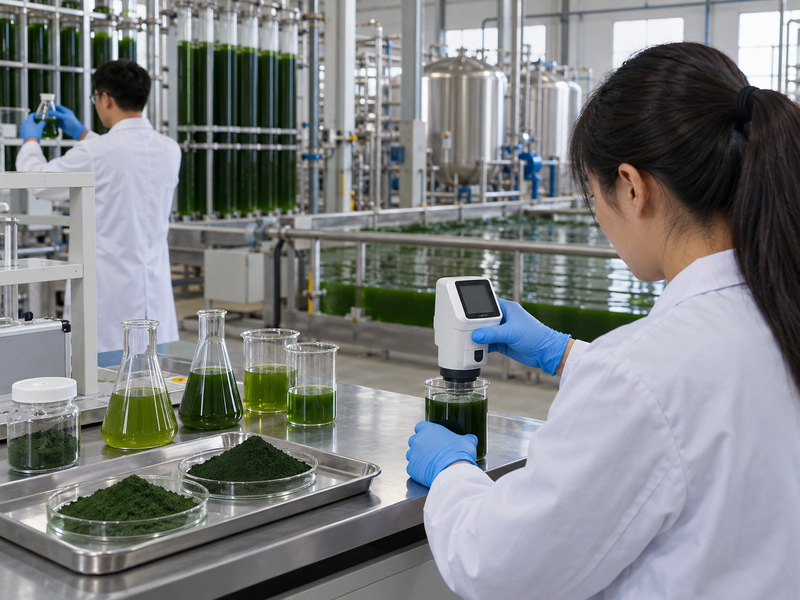
Chlorophyll can help a buyer monitor green-color consistency and understand a formula ingredient. It does not alone certify species, nutrient quality or health benefit. A lot with attractive color may still fail microbiology or elemental limits. Define whether pigment testing protects visual appearance or supports a declared composition target. A chlorophyll result can help control green intensity when visual consistency matters, but it should not carry an identity or health claim. Ask whether the supplier wants the number to support a composition target or merely describe a typical lot. Then verify whether it predicts the shade in your application. A dark powder can give a dull beverage, while a brighter lower-dose powder may work better after dilution. Finished color belongs beside the chemical result in the decision file.
Start with the offer: State the color goal before setting a pigment minimum. Request both a chlorophyll assay and an application sample from the offered lot.
| Buyer check | Evidence to request | Decision it supports |
|---|---|---|
| Pigment result | Defined chlorophyll analytes | Monitor composition |
| Color test | Instrument or coded visual panel | Judge customer appearance |
| Application dose | Grams per finished unit | Connect assay to use |
2. Which pigments are included?
Name analytes accurately
Chlorophyll a and chlorophyll b can be reported separately or as a calculated total. Some methods also track breakdown products that change apparent color. One supplier may report total chlorophyll while another reports only chlorophyll a. A direct percentage comparison without those definitions lacks meaning. Chlorophyll a, chlorophyll b and total chlorophyll are not interchangeable entries. A supplier may calculate total from two absorbance readings while another reports only one analyte. Breakdown products can also affect visual appearance. Ask for the exact result names, units and calculation before comparing COAs. If a finished label calls out a quantity, have the label team decide which analyte and method support it rather than interpreting a general green-color test as a composition guarantee.
Here is the evidence check: Put the analyte names and calculation on the specification. Return any COA that says only “chlorophyll” without a defined method.
3. How do extraction and methods matter?
Check analytical comparability
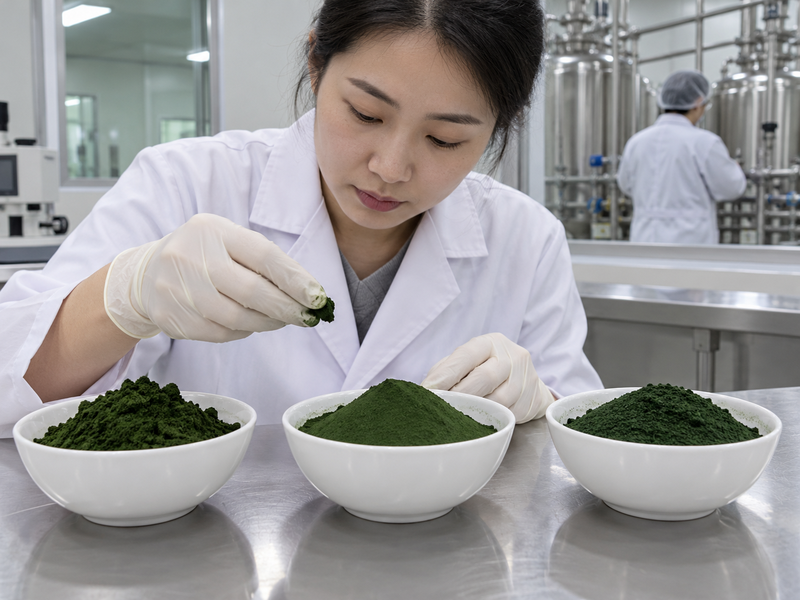
Solvent, extraction time, light protection, absorbance wavelengths or chromatography can influence measured content. Particle disruption can affect extraction efficiency. A buyer should request a method reference and sample preparation notes when pigment is a contractual attribute. A single color photograph is not an assay. Extraction solvent, time, light exposure and particle preparation can all affect a pigment assay. A disrupted powder may release pigments more readily than intact cells under the same extraction, changing apparent content. If two suppliers use different methods, send split samples to one qualified lab or keep the values separate. Ask whether the result came from final powder and how long the sample was stored before analysis. This preserves comparability when color consistency is a purchasing criterion.
Make the comparison fair: Fix one extraction and analysis protocol for supplier comparison. Record sample preparation, method revision and reporting basis.
| Buyer check | Evidence to request | Decision it supports |
|---|---|---|
| Extraction | Solvent, time and protection from light | Compare measured recovery |
| Instrument | Wavelengths or chromatography method | Identify analytes |
| Reporting basis | Dry or as received | Compare lots fairly |
4. Does chlorophyll vary during cultivation?
Expect biological variation
Chlorophyll synthesis responds to light, nutrients and cultivation mode, even within one named species. An original comparison of C. vulgaris and C. sorokiniana cultivation modes reported differences in pigment profiles under defined conditions. That result explains why a species name alone cannot guarantee a fixed shade from every producer. Ask a supplier for pigment and color trends from the same production route, then test those lots in your formula at a constant dose. Set an acceptance range where the finished appearance remains consistent; a research maximum is not a suitable commercial limit. A process or culture change that shifts several pigment results together warrants investigation even if every individual value still passes.
Follow the process trail: Request a multi-lot pigment and color trend. Set a change alert when both measures drift in a way your finished product reveals.
5. How does processing change green appearance?
Consider pigment and particles
Disruption, heat and drying can alter pigment retention and surface color. Two powders with the same analytical result may look different when particle size or hydration differs. Commercial approval needs both a chemical result and an application trial under standard lighting. Drying and cell disruption can change color through heat exposure, oxidation and particle optics. Two powders with similar chlorophyll totals may produce different shades after hydration. Test the proposed ingredient at the intended dose under your product’s pH and processing temperature. If a beverage uses an opaque pack, shelf-light exposure may differ from a clear bottle. An application trial prevents a laboratory pigment result from becoming a poor proxy for consumer appearance.
Try this in a pilot: Measure color in the finished matrix before and after processing. Retain a coded reference sample for future lots.

| Buyer check | Evidence to request | Decision it supports |
|---|---|---|
| Drying | Temperature and exposure history | Investigate color loss |
| Particle size | Final distribution | Explain visual shade |
| Hydration trial | Color after standard dilution | Predict beverage appearance |
6. What happens during storage?
Test the real pack
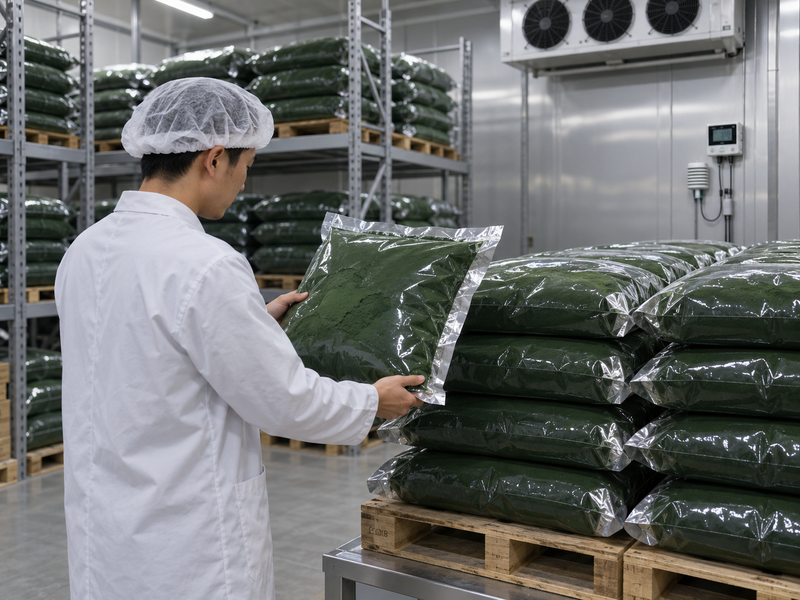
Original research on isolated C. vulgaris chlorophyll studied light and temperature effects in ethanolic solutions. Its exact stability results should not be transferred to whole powder, but the mechanism warrants pack-specific testing. Oxygen, heat and light exposure can matter across distribution. Pigment stability depends on matrix, temperature, light and package. The original C. vulgaris study examined isolated pigments in ethanolic solution, so its precise storage result cannot be assigned to whole powder or a finished drink. Use it to choose stress conditions, then monitor your own product over the intended distribution period. Ask whether the supplier’s shelf-life claim includes pigment data or only microbiology and moisture.
Put it in writing: Test color and chlorophyll in the actual pack at realistic and stressed conditions. Set a review point before visual failure reaches customers.
An original pigment-stability study tested isolated C. vulgaris chlorophyll under defined conditions. Whole-biomass behavior requires separate testing.
7. Can chlorophyll support a medical claim?
Keep evidence proportional
A pigment quantity by itself does not demonstrate detoxification, disease prevention or any clinical effect. Claims depend on product, dose, evidence and market law. Procurement should not turn a COA number into consumer copy without scientific and regulatory review. A COA showing chlorophyll quantity does not establish detoxification or disease outcomes. Keep analytical composition, visual performance and health claims in separate review tracks. If a sales team wants to use pigment data in consumer copy, ask what exact statement is proposed, what evidence supports it and which market rules apply. A procurement assay can be scientifically sound while still being insufficient for a clinical promise.
At receiving, check this: Use the result for specification and color consistency. Route any consumer health statement to scientific and regulatory review.
| Buyer check | Evidence to request | Decision it supports |
|---|---|---|
| COA statement | Pigment number and unit | Document composition |
| Marketing claim | Exact proposed consumer wording | Require separate substantiation |
| Regulatory review | Destination-specific decision | Avoid unsupported health claim |
For US supplement manufacture, FDA’s CGMP guide addresses component specifications. It does not turn a chlorophyll COA into evidence for a medical statement.
8. How should a specification express pigment?
Set a reproducible range
State analyte, unit, dry or as-received basis, method and acceptable range. An upper limit can sometimes matter as much as a minimum when flavor or dark color creates formulation trouble. Include a color assessment if final appearance is the actual business need. Specify chlorophyll a, b or total, method, unit, basis and a range tied to application performance. If a very dark shade becomes a problem, an upper bound or a color target may be more useful than a minimum alone. Ask for assay repeatability and historical lot spread before choosing tight limits. Include instrument color conditions if visual acceptance depends on light source or product dilution.
Watch the risk pathway: Draft separate pigment and color criteria with methods. Validate both on multiple approved lots in the finished matrix.
9. What should a formulation trial measure?
Check the complete matrix
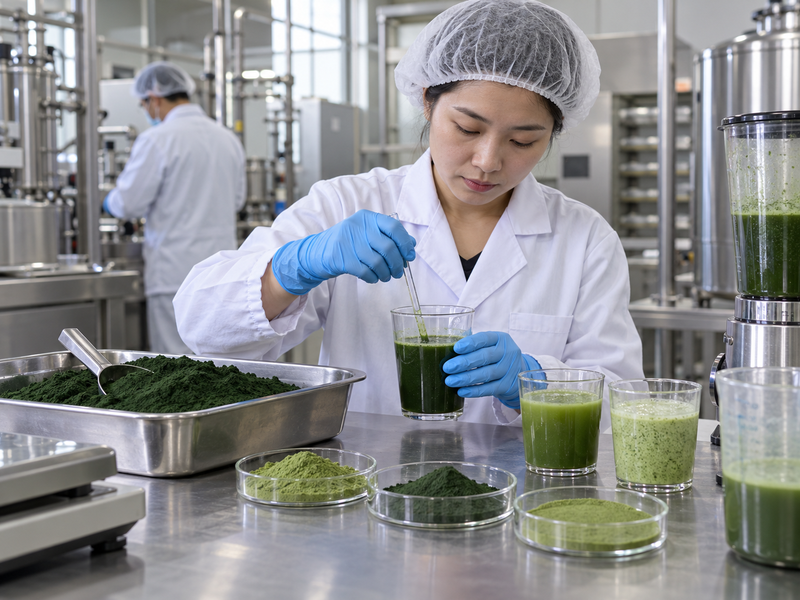
Test color at launch, after processing and through the expected shelf life. Compare pH, heat, light exposure and package transparency relevant to your product. Measure sensory effects too: a stronger green signal may accompany a stronger algal note. Trial at launch dose, at the highest permitted dose and after the planned process. Measure appearance immediately and through shelf life; collect sensory notes because a greener result may bring a stronger algal flavor. Compare samples under identical lighting and pack conditions. If a formulation includes acid or heat, include those steps in the pilot. Record which parameter—pigment number or visual panel—best predicts an acceptable consumer product.
A staged color trial can reveal where loss occurs. Record the powder shade, freshly mixed formula, product after any heat or acid step, and product at planned shelf-life checks. Photograph all samples under one light source and retain instrument readings if color drives acceptance. Test flavor at the same points; an ingredient that keeps a vivid green but develops an unacceptable note cannot solve the formulation problem. This links the pigment assay to the customer experience.
Count usable output: Run coded stability trials with the actual formula and package. Choose a dose that satisfies both color and sensory targets.
| Buyer check | Evidence to request | Decision it supports |
|---|---|---|
| Launch sample | Color and taste at target dose | Set baseline |
| Processed sample | Color after heat or acidity | Assess manufacturing effect |
| Shelf sample | Color under final package storage | Set stability range |
10. What is the final buyer action?
Pair chemistry with use
Ask for a method-matched pigment series, process description, reference samples and shelf-life data. Trial them in the finished matrix, then agree on a release range that predicts visible consistency. Retain flexibility for biological variation without losing customer expectations. Supplier approval should connect pigment assay, reference shade, process route and shelf-life evidence. Ask how pigment results are trended and which process changes could affect them. Keep lot-specific data rather than one typical value. If a new grade offers a stronger color, test whether it changes flavor or stability before changing the specification. The defensible decision is the ingredient that delivers repeatable finished-product appearance within approved safety limits.
For a multi-product brand, a single pigment target may not serve every SKU. A dark green tablet can be acceptable while the same powder creates an overly strong note in a lightly flavored drink. Record each application’s dose, desired shade and sensory limit beside the supplier grade. If one grade cannot satisfy both, approve separate grades instead of broadening one specification until it no longer protects either product.
The decision point: Approve a method-matched range and reference color. Require a fresh trial after a material change in cultivation, disruption or drying.
FAQ
Does a darker powder always contain more chlorophyll?
No. Particle size, drying and breakdown products affect appearance. Check the assay and product trial.
Are chlorophyll a and total chlorophyll interchangeable?
No. Name the analytes and calculation in each report.
Can an extract stability paper set whole-powder shelf life?
No. Use it to design testing, then study the actual powder and finished pack.
Does a chlorophyll result support detox claims?
No. A pigment assay cannot demonstrate a clinical outcome.
How should color be approved?
Use coded samples in the final formula under standard lighting and planned storage conditions.
Practical next step
Define whether pigment data protects a composition target, a color target or both. Request method-matched lot results, then test coded samples in the actual formula and package through expected storage. Keep any consumer health statement outside the pigment release decision. The powder specification guide helps turn the chosen method and range into a supplier requirement. A reliable green appearance starts with a repeatable assay and a successful product trial.