
A chlorella broken cell wall process can affect how a powder behaves in extraction, digestion studies, and food formulation. Yet “broken cell wall” is often printed on a sales sheet without a defined test, a sample method, or a result for the lot being sold. For a bulk buyer, the useful question is what was done to the cells and how the supplier shows the result.
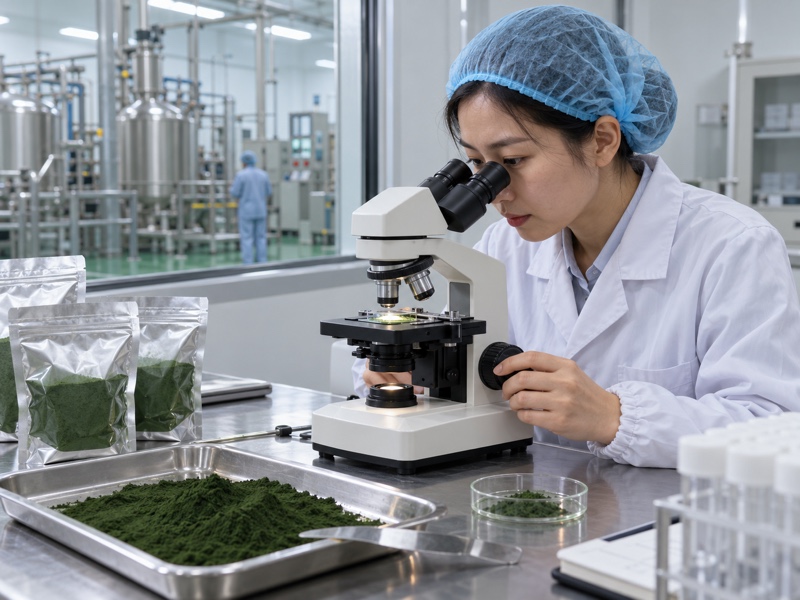
Our catalog confirms chlorella powder and tablets. It does not establish that either is cell-disrupted, nor does it specify a disruption method. Ask for the current grade specification and lot records before treating a broken-cell claim as a feature of a particular product. Our blue spirulina versus chlorella guide clarifies why those ingredients are not interchangeable. The guide below explains the evidence a food or supplement buyer can request.
1. What does “broken cell wall” mean on a chlorella specification?
Define an assay and denominator
The phrase should describe a measurable change to chlorella cells, not just a product name. A supplier may use it to mean that a treatment fractured some cells, made the wall more permeable, released more intracellular material, or changed the appearance under microscopy. Those outcomes overlap, but they are not identical. A powder may be ground finer without a demonstrated increase in the proportion of disrupted cells. Conversely, a wet process may release soluble material without making the final powder especially fine.
First, ask the supplier to state its operational definition: the analytical endpoint, method, number of fields or particles counted, sample preparation, and acceptance criterion. Request a result for the actual production lot. If the specification says “95% broken,” the buyer should be able to learn whether that number refers to cells, particles, mass, or a proxy signal. Without the denominator and method, a percentage is not portable between suppliers.
| Claim on a sheet | What it may describe | Better buyer question |
|---|---|---|
| “Broken cell wall” | Some degree of cell rupture | Which assay and lot result support it? |
| “Fine powder” | Particle size after milling | Does microscopy show opened cells? |
| “High bioavailability” | A proposed nutrition effect | Which food-relevant study supports this grade? |
| “Easy to extract” | Release under one solvent and protocol | Does the result hold for our process? |
Then, keep the agreed definition in the purchase specification. A process or test-method change becomes visible before the next order.
2. Why is the chlorella wall a processing challenge?
Connect wall structure to process
Cell-wall composition and resistance vary with species, strain, growth conditions, and cell state. In a peer-reviewed study of *Chlorella vulgaris*, Weber and colleagues compared mechanical and chemical treatments and measured released protein and carbohydrate. They found the wall difficult to disintegrate and traced its resistance to structural features. The paper also cautions that older studies can be hard to compare because taxonomy and biological conditions differ.
Therefore, the buyer should avoid assuming that a result for one *C. vulgaris* laboratory sample applies to every commercial chlorella. Ask for the organism named in the specification and for evidence that the selected test works on the supplier's material. A useful comparison uses the same biomass before and after the proposed treatment. It controls moisture basis, sample concentration, and measurement protocol. Without a matched untreated control, a high protein-release result might reflect a naturally different starting material rather than an effective process.
For whole chlorella tablets, the relevant question also includes downstream compaction. A tablet made from treated powder may still have different disintegration behavior from loose powder. The wall treatment, final particle distribution, and tablet formulation need separate records.
3. Which mechanical approaches appear in research?
Compare mechanical treatments
Published work uses methods such as bead milling, ball milling, high-pressure homogenization, and ultrasonication. Weber's study compared several of these on a defined laboratory sample. A rat protein-quality study also examined mechanical disruption, but its nutritional findings cannot be turned into a universal human outcome. Research methods show what can be measured, not what a particular commercial supplier actually does.
| Approach in research | Typical physical action | Evidence a buyer should request |
|---|---|---|
| Bead or ball milling | Collisions and shear | Particle distribution, temperature, wear control, disruption assay |
| High-pressure homogenization | Pressure drop and shear in a liquid stream | Pass count, process temperature, cleaning, before/after assay |
| Ultrasonication | Cavitation in a liquid | Energy exposure, scale, temperature, assay repeatability |
| Dry grinding | Fracture under milling force | Fineness and separate cell-integrity evidence |
However, no row is a recommendation for your food line. Mechanical intensity can increase temperature, create fines, or alter oxidation and color. A pilot should evaluate the final ingredient, not just a microscope image. If the supplier names a method, ask whether it is used at commercial scale on the lot offered and how the critical settings are controlled.
4. Do chemical and enzyme methods establish food suitability?
Separate extraction from food suitability
No. Laboratory researchers may use acid, alkali, or enzymes to investigate wall chemistry or maximize release for biorefinery work. In Weber's study, alkaline hydrolysis gave strong protein and carbohydrate solubilization under the tested conditions. The study was not a clearance document for a food ingredient made with that treatment. Its temperatures, reagents, and endpoints should not be copied into a buyer specification without considering residuals, ingredient identity, quality, and destination-market requirements.
By contrast, an enzyme process raises different questions: enzyme source, activity, processing aid status in the intended market, inactivation or removal where relevant, and whether the same enzyme is used on the commercial lot. Chemical treatments raise questions about neutralization, residue testing, equipment compatibility, and changes to the product's composition. A supplier saying “natural process” is not enough to answer them.
If the offered grade is a whole biomass ingredient, determine whether the treatment keeps it as whole biomass or separates constituents. That distinction can affect labeling and regulatory review. Have the responsible regulatory team assess the actual process and intended use. Do not infer food suitability merely because a peer-reviewed paper reports high extraction yield.
5. How can disruption be measured without relying on one number?
Use complementary measurements
Instead, use complementary methods. Microscopy can show cell morphology and count visibly disrupted cells, provided sample preparation does not itself break them. Permeability dyes can indicate access through the wall, but the dye protocol and fluorescence threshold matter. Soluble protein or carbohydrate release can show what escaped under a specified extraction step; it may be influenced by initial composition, dilution, and assay interference. Particle-size data describes powder handling, not necessarily wall integrity.
| Measurement | What it supports | Main limitation |
|---|---|---|
| Before/after microscopy | Visible cell morphology and counted rupture | Operator and image-selection effects |
| Stain or permeability assay | Increased access through wall | Threshold and dye chemistry vary |
| Soluble protein release | Recovery under a defined extraction | Not a direct percentage of broken cells |
| Particle-size distribution | Fineness and dispersion planning | Fine particles can include intact cells |
| Matched application trial | Performance in the buyer's process | Specific to that formulation and conditions |
Then, ask for the method, raw counts or curves, replicate results, and a matched untreated comparator. If one lot “passes” by microscopy but fails to release material under the buyer's process, the chosen assay may not be predictive enough for that use. A buyer can specify an outcome in its own application rather than demanding a supplier's proprietary machine settings.
6. What does the digestibility evidence actually show?
Limit claims to the tested product
Disrupting a tough wall may make nutrients more accessible, but evidence depends on species, test model, and product. A human crossover study of whole and split chlorella measured post-meal blood amino-acid responses under controlled conditions. A rat study tested protein quality and mechanical disruption for selected green microalgae. These studies help frame questions; they do not demonstrate that every processed chlorella powder delivers the same human benefit or that a supplier can make a therapeutic claim.
Next, review what the study actually tested. Was the organism the same? Was the treatment comparable? Was the dose a whole food, isolated protein, or supplement? Was the endpoint in vitro release, animal digestibility, or a human response? A commercial grade may include a different harvest condition, drying step, storage history, or tablet formulation. Ask the supplier to identify a study on its own product if a quantified absorption claim is made.
In practice, a food developer’s first decision may be simpler: does the treated powder disperse, taste, color, and process acceptably at the intended use level? Nutritional claims and product performance should be evaluated separately.
7. Which safety and quality controls belong in the dossier?
Map controls to each process step
Meanwhile, cell disruption is an additional manufacturing step and can change contamination and degradation risks. Ask the supplier how it controls contact surfaces, cleaning, foreign material, temperature, holding time, and moisture after treatment. A wet process also needs a documented path back to a stable powder. A dry process needs control of dust, wear particles, and cross-contamination. The exact hazards and controls depend on the actual equipment.
For US dietary supplement use, FDA's current good manufacturing practice guidance explains the need for specifications covering identity, purity, strength, composition, and contaminant limits. Food applications have their own applicable requirements; the buyer's quality team should map those to the intended market. Do not treat a “broken cell” result as a substitute for microbiology, contaminants, species identity, or traceability.
| Dossier item | Buyer purpose | Useful question |
|---|---|---|
| Process flow and change record | Know where treatment occurs | Was the sample made on the commercial line? |
| Lot COA and specification | Check agreed quality attributes | Which tests apply to this batch? |
| Disruption method report | Verify the claim | How many replicates and controls were used? |
| Food safety controls | Assess step-specific hazards | What is monitored and released? |
| Retained sample and lot trace | Investigate later differences | Can the tested sample be matched to cartons? |
The best dossier is concise enough for the buyer's teams to use and detailed enough to reproduce the decision on the next lot.
8. How might the process change powder handling?
Test the finished powder
Ruptured cells can change surface area, fines, wettability, color release, and the way powder behaves in mixing. Those effects are plausible process considerations, not guaranteed benefits. The buyer should test the offered grade in its own formulation against an untreated or alternative chlorella grade. Keep solids level, mixing energy, water temperature, pH, and hold time constant. Record both immediate dispersion and any sediment or viscosity change after the product sits.
Likewise, for tablet production, check powder flow into the press, compression behavior, hardness, friability, and tablet disintegration. A powder that is easier to extract may be more difficult to feed consistently if it contains many fines or takes up moisture. For beverages, a faster color or nutrient release does not necessarily mean a stable suspension. The outcome depends on the whole formulation, not only on cell rupture.
Packaging and storage tests should follow the actual process. If the supplier has generated a new high-surface-area powder, ask whether the shelf-life evidence covers that treated grade. Compare sealed and opened-pack handling under realistic production conditions instead of carrying over a shelf-life statement from a different material.
9. What should a buyer ask a manufacturer before approving samples?
Request grade-specific evidence
Send a short technical request that separates identity, process, evidence, and performance. First, request the organism, grade name, specification, and intended product form. Second, ask whether the supplied grade is actually treated to disrupt cells and whether that step is performed by the manufacturer or an outside processor. Third, request a lot-specific test report with method and result. Fourth, ask for quality records relevant to that step. Finally, request enough of the exact commercial grade to run a matched pilot.
| Request | Why it matters | Decision if missing |
|---|---|---|
| Exact grade and lot identity | Prevents sample/commercial mismatch | Do not approve by name alone |
| Process description | Defines what “broken” means | Treat claim as unverified |
| Before/after assay | Shows an actual treatment effect | Run independent comparison |
| Food safety evidence | Assesses process hazards | Escalate to quality review |
| Change-notice terms | Protects recurring supply | Add to purchase agreement |
Protect legitimate proprietary details: a buyer may not need every machine setting. It does need a defined result, a stable process, and timely notice when changes could affect the approved grade. Put the test and change-control obligations in the supply agreement, not only in an email from a sales contact.
10. How should a buyer compare treated and untreated lots?
Run a matched commercial trial
Finally, use a blinded or clearly coded paired test when possible. Request representative treated and untreated samples of the same species and comparable harvest or production period. Confirm the same moisture basis and target particle size where feasible. Measure the supplier's claimed endpoint and the buyer's own application endpoint. The comparison should be reproducible across at least two lots before a recurring order depends on it.
The decision is not simply which sample has the highest rupture figure. Choose the grade that meets the application, safety, labeling, and cost requirements together. If the broken-cell claim is material to the buying decision, record the assay and acceptance threshold in the specification. If the buyer only needs reliable green color or protein content, a more elaborate process may not provide value.
FAQ 1: Are all commercial chlorella powders broken-cell products?
The catalog name “chlorella powder” does not establish a disruption step. Ask for the specific grade's process description and lot evidence.
FAQ 2: Does a smaller mesh size prove the walls are broken?
Mesh size describes how particles pass a sieve. Cell integrity requires a separate assay such as microscopy or a validated permeability or release method.
FAQ 3: Is chemical disruption automatically acceptable for food?
A laboratory extraction result does not establish food suitability. Evaluate the actual reagents, residues, ingredient identity, intended use, and applicable market requirements.
FAQ 4: Does breaking cells guarantee better human absorption?
Some studies find differences under defined conditions, but species, treatment, product format, and measured endpoint matter. Avoid universal absorption claims.
FAQ 5: What is the minimum evidence for a purchase trial?
Start with a current specification, actual lot COA, a defined disruption assay, process and safety summary, and representative sample. Add application testing before commercial approval.