
Can you bake with spirulina powder and still get a pleasant green product? Yes, but raw powder color does not predict the finished crumb or flavor. Heat, browning and recipe ingredients can turn a bright-looking mix darker while spirulina adds a savory note. This guide uses published bakery trials and practical small-batch testing to help home bakers and food brands decide where whole green spirulina works best.
Contents
- What kind of spirulina belongs in a recipe?
- What happens to color during baking?
- How much powder should a trial use?
- How might flavor change the bake?
- Which baked foods are easier to test?
- Can spirulina replace flour or protein?
- Would adding it after baking work better?
- How do you run a fair kitchen trial?
- What claims can a baker make?
- When is spirulina worth using?
1. What kind of spirulina belongs in a recipe?
Use whole green biomass for this guide
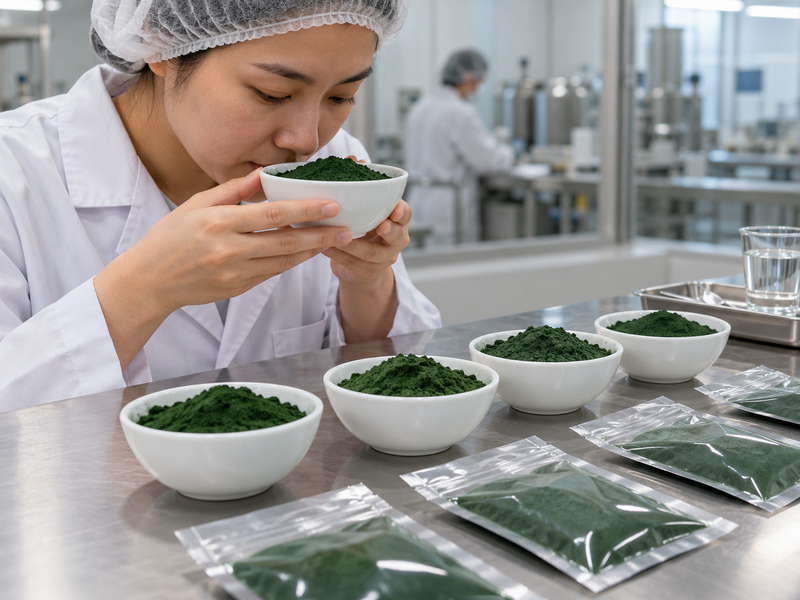
Green spirulina powder is dried whole Arthrospira biomass. It contributes solids, flavor and a deep green color to a dough or batter. Blue spirulina normally describes a phycocyanin-rich extract used primarily for blue coloring; it is not interchangeable with whole powder in a recipe. Their pigment concentration, flavor and behavior in heat differ. Before testing a formula, read the ingredient statement and confirm whether your supplier is offering pure whole biomass, an extract or a blend with carriers.
The green spirulina product description separates whole biomass from the blue extract category. That distinction saves a failed bake: a recipe developed for one ingredient may not give the same color or nutrition when the other is substituted. Weigh the powder and record its lot, moisture and texture.
Whole spirulina can change dough hydration or batter viscosity at higher inclusions, so treat it as an ingredient with physical effects, not as a few drops of food dye.
2. What happens to color during baking?
Expect a different shade after heat
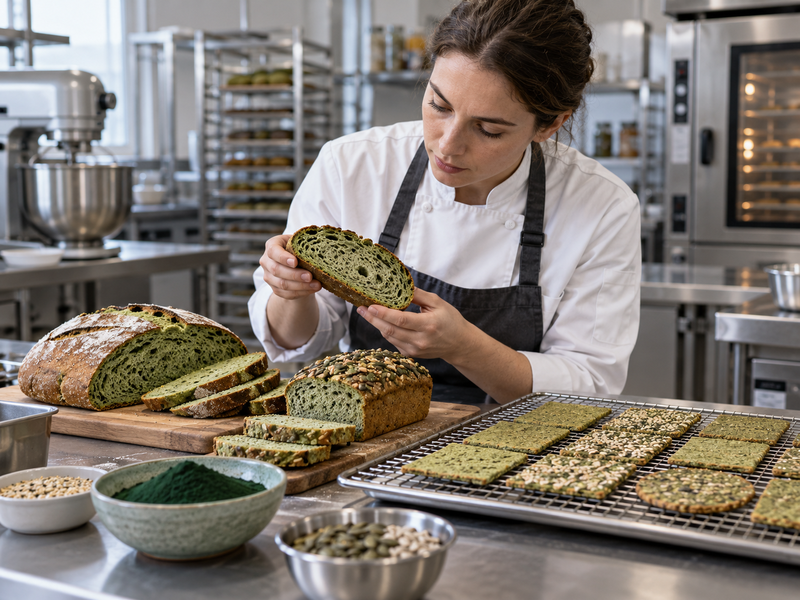
Spirulina can color an unbaked dough visibly, but the finished crust and crumb will not necessarily remain vivid green. Baking introduces heat, oxygen and browning reactions, while other recipe ingredients can shift appearance. In a study of spirulina-enriched cookies, baked cookies with added biomass were darker than controls. A bread study likewise found darker crust and crumb and measurable color changes at low inclusion levels.
Those findings concern particular formulas and do not predict every oven or flour.
Photograph raw dough, just-baked product and cooled slices under the same lighting. Compare internal crumb with the exterior, since a dark crust can hide a different interior shade. The useful expectation: aim for an appealing natural green-brown hue unless your own trial demonstrates something brighter. If a sales image promises emerald bread, validate that color after actual baking, packaging and shelf display. Do not choose a powder solely by how bright it looks in the jar.
| Stage | What to inspect | Common surprise |
|---|---|---|
| Raw batter | Initial dispersion | Streaks or clumps |
| After baking | Crust and crumb | Darker hue |
| After storage | Color consistency | Fading or oxidation |
3. How much powder should a trial use?
Begin with a small, measured inclusion
There is no universal dose that guarantees good color and flavor. Bakery studies often test defined percentages of flour or total recipe weight, and those denominators are not equivalent. The cookie trial used one and two percent biomass additions, while the bread study tested low-level enrichment. Treat such values as research examples, not automatic instructions for your recipe. Start with a plain control and at least two small weighed additions.
Keep every other ingredient and the bake schedule unchanged so you can identify the effect of spirulina.
For a home batch, write down grams of powder, flour and total batter. For a business, state whether inclusion is a percentage of flour weight or total formula weight on every trial sheet. This little detail prevents confusion: “two percent spirulina” could mean two grams per 100 grams of flour or per 100 grams of finished mix. Evaluate taste before increasing the dose for color. If a stronger green creates an aftertaste customers dislike, a lower inclusion or a post-bake application may be the better product.
4. How might flavor change the bake?
Expect savory and marine notes at some levels
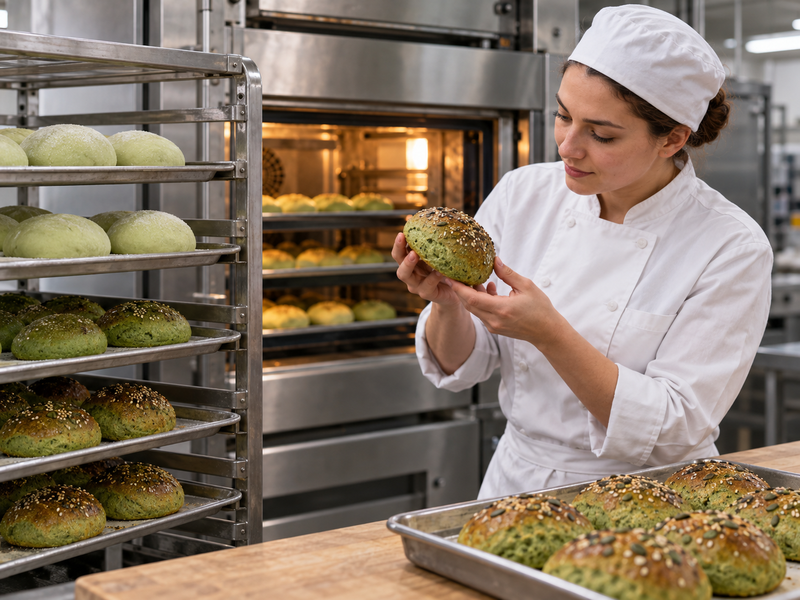
Whole spirulina has its own taste. In the bread study, trained sensory evaluation found stronger bitter and marine-related notes in enriched samples. A chocolate cookie, spiced cracker and plain white loaf will mask those notes differently. Sweetness can soften a flavor edge without removing it, and a higher dose used for color can make the aftertaste more obvious. Fat, salt, acid and baking aromas all affect the finished impression. Taste the cooled product, not just warm samples straight from the oven.
Try a blind comparison: offer tasters the control and two inclusion levels without saying which contains spirulina. Ask about aroma, bitterness, marine note and willingness to eat a full portion. For brands, include intended consumers rather than relying only on a development team accustomed to algae flavors. Pairing spirulina with assertive savory ingredients may work better than forcing it into a delicate vanilla biscuit. Record the flavor outcome beside the color score so the visually strongest version does not win by default.
| Recipe style | Likely flavor issue | Trial response |
|---|---|---|
| Plain bread | Exposed marine note | Start low |
| Chocolate cookie | Possible masking | Check aftertaste |
| Savory cracker | Flavor may fit | Test salt balance |
5. Which baked foods are easier to test?
Match the ingredient to the food’s character
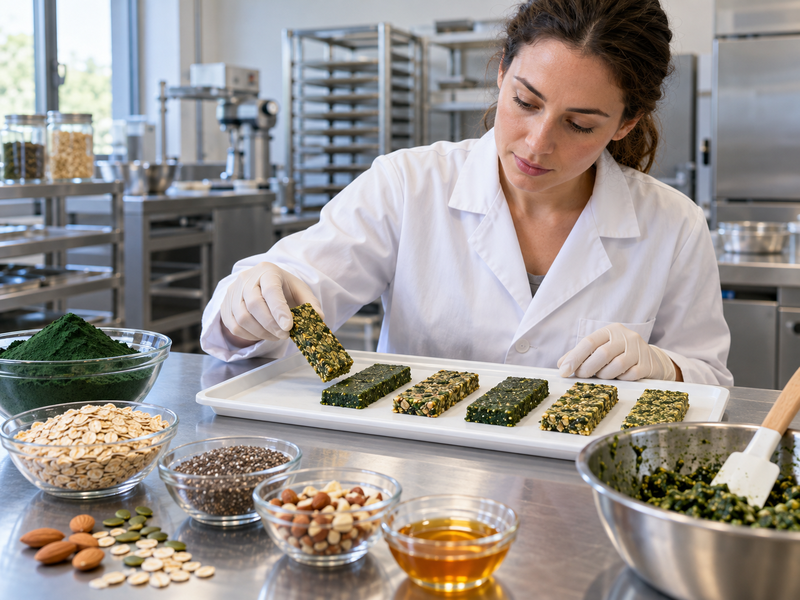
Small crackers, seeded breads and savory flatbreads can accommodate a stronger green flavor than a delicate sponge cake. Dense bars may offer another useful route, although a low-temperature or no-bake bar is a different process from a fully baked product. Cookies are easy to portion into test batches and compare, but browning can make their color much darker. Bread adds the complication of dough development and fermentation. A recipe that works in one category should not be copied into another without a new trial.
Start with the product customers already want, then ask whether spirulina adds a reason to buy it. A practical sequence: test a small savory item for flavor, a pale dough for crumb color and the commercial target recipe for final acceptance. Do not rely on a staged raw-dough photograph as evidence for the final food. If the main goal is vivid color, a cold frosting or post-bake filling may be easier to control than a hot oven. The culinary purpose should lead the ingredient decision.
6. Can spirulina replace flour or protein?
Keep structure and nutrition separate
Spirulina powder is not a direct flour replacement. Wheat flour supplies starch and, in many bread formulas, gluten-forming proteins that shape the dough. Spirulina contributes different solids and can change water demand, texture or color. At low inclusion, it behaves as an added ingredient rather than the main structure of the bake. Substituting a large flour fraction without adjusting the recipe risks a dense or unbalanced product.
The published cookie and bread trials examined particular inclusion levels and measured their own physical outcomes; they do not establish a universal substitution rate.
The dry powder may be protein rich, but any claim about the finished snack must use the actual portion and applicable labeling rules. Do the arithmetic: if a recipe has only a small amount of spirulina spread across many servings, its protein contribution per cookie may be modest. Analyze the final product if a nutrient claim is central to the package. A well-textured bake with accurate language is a stronger product than a visually dramatic one that overstates what a small green addition delivers.
| Function | Flour | Whole spirulina |
|---|---|---|
| Structure | Main dough matrix | Added solids |
| Flavor | Recipe-dependent | Distinct green note |
| Protein claim | Finished recipe matters | Contribution must be calculated |
7. Would adding it after baking work better?
Consider a cool component when color leads
If a vivid green appearance is the main objective, a post-bake filling, glaze or topping may avoid exposing the ingredient to the full oven cycle. That does not mean every cool preparation is stable indefinitely; acidity, light, refrigeration and shelf time still need testing. A frosting with spirulina may have more visible green color than a browned cookie, but it can also carry a stronger raw flavor. Texture and hygiene matter, especially for ready-to-eat fillings added after heat processing.
Make a side-by-side comparison: spirulina in the batter, in a post-bake component and in both at smaller amounts. The result to watch: does a lower total dose achieve the desired appearance without an intrusive taste? For commercial products, validate the finished assembly’s microbiological controls and shelf life. Do not assume that moving an ingredient after baking preserves every nutrient or produces a health benefit. It is a formulation tactic aimed at a better sensory and visual outcome.
8. How do you run a fair kitchen trial?
Change one factor at a time
Use one powder lot, one base recipe, identical pan sizes and a consistent bake schedule. Weigh every component rather than relying on spoon volumes. Prepare a control, low-dose and higher-dose batch, then record dough handling, finished color, texture, taste and yield. If the higher level needs more liquid, run a separate adjustment trial after the basic comparison; otherwise you cannot tell whether spirulina or extra water produced the difference. Repeat the most promising version before committing it to a menu or package.
For a business, measure color under fixed light and test after expected packaging and storage. A factory ingredient specification can help define powder grade, but it cannot substitute for a finished-food trial. One more useful step: compare the actual cost per saleable unit, including rejected bakes. If a lower dose gives consistent color and good flavor, it may be better than a richer recipe that needs aggressive masking or produces too many off-color pieces.
| Trial record | Why keep it | Decision it informs |
|---|---|---|
| Powder grams and lot | Reproducibility | Reorder control |
| Bake time and temperature | Process comparison | Scale-up |
| Color and taste score | Consumer acceptance | Final dose |
9. What claims can a baker make?
Describe the finished food truthfully
“Made with spirulina” is an ingredient statement when the recipe really contains it. “High in protein,” “supports immunity” or a disease-related promise asks for different evidence and regulatory review. The FDA’s label-claims overview explains how conventional-food and supplement claims are treated and why disease language is not an ordinary food claim. A powder’s laboratory antioxidant activity does not prove a baked cookie delivers a clinical benefit.
Test the finished food for any nutrient quantity you want to feature, especially when heat and serving size matter. Keep the copy grounded: mention the ingredient, describe the actual color and flavor, and state a tested amount if relevant. Do not imply the bake remains brilliant green unless customers see that result in the product they receive. Food photography should show a normally baked and stored item rather than raw batter or a heavily edited slice.
Clear, modest copy builds repeat purchases better than a claim that the first bite contradicts.
10. When is spirulina worth using?
Judge the final bake as food
Use whole green spirulina when its color, flavor and ingredient story improve a recipe customers already enjoy. It can work in bread, cookies or savory snacks, but results depend on the matrix and dose. Baking may darken color and expose marine or bitter notes, so a bright dry powder is not enough reason to purchase a bulk lot. If the goal is vivid green alone, compare a lower-heat or post-bake component and consider whether whole biomass is the right ingredient form.
Run a small measured trial and set pass marks for taste, color, texture and cost before scaling. The strongest answer to the opening question: yes, you can bake with spirulina powder, and you should choose the recipe by its finished quality. Keep supplier documents and serving calculations beside your trial notes. Then you can offer a product that looks like its photograph, tastes good and makes claims the actual bake can support.
| Goal | Better starting trial | Pass mark |
|---|---|---|
| Savory flavor | Cracker or flatbread | Pleasant aftertaste |
| Green crumb | Pale bread | Finished color |
| Vivid surface | Cool topping | Color after storage |
Frequently asked questions
Will spirulina stay bright green in the oven?
Not reliably. Studies in bread and cookies found darker finished products. Test your own recipe after baking and storage.
Can I use blue spirulina instead?
Blue extract is a different ingredient. Test it separately; do not substitute it gram for gram for whole green biomass.
Does spirulina make cookies high in protein?
Not automatically. The finished cookie’s protein per serving and local claim criteria decide whether that statement is supportable.
How do I reduce its marine taste?
Start with a lower weighed dose and try a recipe whose flavors fit the powder. Judge the cooled finished food.
Is a no-bake bar the same as baking with spirulina?
No. It can be a useful formulation option, but its processing and shelf-life requirements differ from a baked item.
Conclusion
Spirulina can be baked into appealing foods, provided the final color and taste are tested rather than assumed. Whole green powder behaves as a real ingredient, not an invisible dye or flour substitute. Begin with small measured batches, compare the cooled products and use accurate serving-based claims. A good spirulina bake should earn its place on flavor and appearance before its green ingredient story reaches the package.