
What is spirulina extract? The word extract sounds precise, but it says little about composition on its own. Two suppliers can use the same name while one offers a blue protein-pigment preparation and another describes a different fraction or a blend with carriers. Buyers need to know what is in the bag, how it was obtained, and which claim or use the material can actually support.
1. What is spirulina extract?
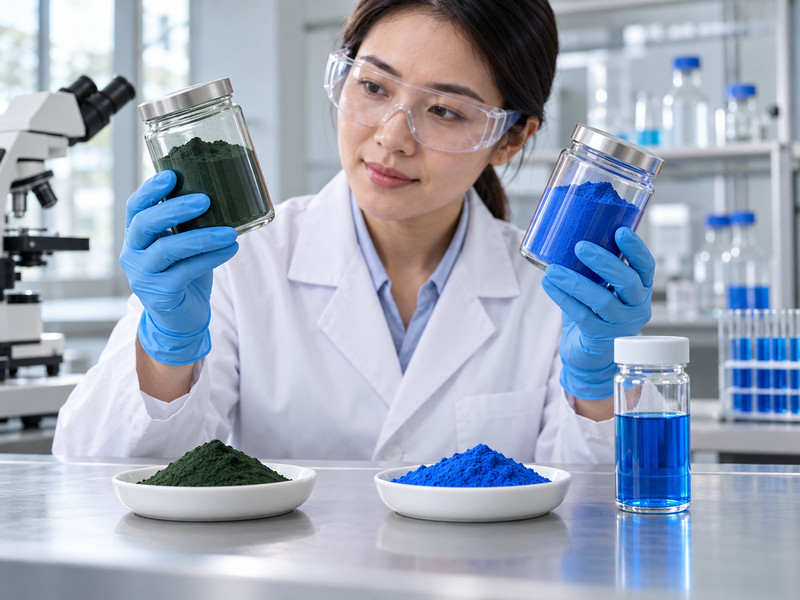
Spirulina extract is a preparation obtained from cultivated spirulina biomass, often selected for the blue phycocyanin-containing fraction
The commercial name does not guarantee a particular concentration. Read the specification and method before comparing offers.
A product name is not a compositional analysis. Start with a full ingredient statement, source organism, source site, manufacturing site, and a process summary. Put the proposed use beside that identity: a food color, a supplement component, and a cosmetic ingredient can face different requirements. Ask whether the blue fraction is isolated, concentrated, or blended with a carrier. Whole green spirulina powder should be listed separately. The record should allow another reviewer to trace a shipped lot back to the material that was approved.
A blue hue identifies a visible property, not a source organism or level of purity. Tie every claim to a document and assay.
2. How does an extract differ from whole spirulina?
Whole biomass retains a wider mix of constituents and usually has a green appearance
Extraction changes composition and application behavior. A study on whole spirulina is not direct evidence for a purified blue pigment; a nutrition panel for whole powder cannot be copied to an extract.
Clarify the question before comparing documents. Is the buyer trying to identify the biological source, understand processing, support an organic claim, or qualify an application? Each needs a different record. A photo of cultivation ponds can illustrate origin, but it does not establish species, site, certification, or batch traceability. Request a process-flow document at an appropriate level of detail and reconcile the names on it with the label, invoice, and certificate of analysis. Unresolved inconsistencies should hold approval.
Trace the source through harvest, extraction, drying, and packing. If different companies perform those steps, reconcile legal names and sites.
| Decision point | Evidence to retain | Decision or check |
|---|---|---|
| How does an extract differ from whole spirulina | Source and process-flow record | Is the organism and origin traceable? |
| What should the source organism record say | Full composition and carrier list | Does the shipped grade match the file? |
| Changed source | Dated decision and retained record | Recheck traceability |
3. What should the source organism record say?
Ask for the organism name used in cultivation, the production site, and the chain from harvested biomass to final lot
Terminology around Arthrospira and spirulina can vary across records; reconcile the supplier documents rather than guessing from a marketing label.
Define analytical terms in the specification. A reported pigment figure needs a method, reference basis, and units. Moisture, color, microbiological limits, and any relevant contaminants also need methods and acceptance criteria. A grade code by itself does not tell the buyer the percentage of phycocyanin or the legal identity. Ask for recent lot data to see normal variation, not only a target value. Retain a sample from the qualified lot so a later change in appearance can be investigated rather than argued from memory.
Separate the pigment assay from total protein and color measurements. Each answers a different question about the material.
4. Which constituents should be specified?
Request an assay for the relevant blue pigment, moisture, carrier ingredients, and other properties tied to your use
Define whether the assay reports pigment, total protein, or another basis. A grade code such as E18 is not a stand-alone percent declaration.
The review of spirulina cultivation and extraction describes multiple ways of obtaining valuable fractions from biomass. It is a map of possibilities, not a process disclosure for a particular supplier. Ask which broad stages apply to the offered grade and what controls protect quality at each handoff. Changes in extraction, separation, drying, or carriers can alter the final material even when the organism stays the same. Keep proprietary settings out of the commercial article, but require enough information for safety and legal review.
A process summary should explain what happens to the biomass without disclosing proprietary equipment settings.
| Decision point | Evidence to retain | Decision or check |
|---|---|---|
| Which constituents should be specified | Assay method and reporting basis | Can these grade figures be compared? |
| How is the blue fraction separated | Process-stage controls | Are critical steps documented? |
| Changed assay | Dated decision and retained record | Rebaseline lot trends |
5. How is the blue fraction separated?
Common process descriptions include cell disruption, aqueous extraction, clarification, concentration, and drying
Ask which steps and aids apply to the grade offered. Processing conditions influence color, microbiological control, and the material that remains in the finished powder.
A blue powder can fade or behave differently after moisture and heat exposure. Phycocyanin stability research points to pH, light, and temperature as test variables. Confirm how the supplier packages the material, its stated storage conditions, and the basis of its shelf life. Then test the ingredient in the buyer’s intended matrix. A shelf-life statement for unopened powder cannot guarantee identical performance after dispersion into an acidic drink or a heated confection.
Storage and carrier composition can affect how a nominally identical grade behaves after shipment.
6. What can make two extracts behave differently?
Carrier choice, particle size, residual moisture, and process history can change flow, dispersion, and stability
Compare the materials in the intended food, not only in a clear glass of water. Retain reference samples from the exact tested lots.
Commercial comparisons should normalize to a relevant result. Price per kilogram is less useful than cost per unit of verified color or per acceptable finished product. Carrier content, concentration method, and transport conditions can change that figure. Ask how the supplier handles out-of-spec lots and whether it will notify customers about a source or process change. The goal is repeatable production, not the brightest first sample. Document the reason for selection so purchasing can protect it when prices change.
Normalize quotes to useful blue fraction or finished-product performance; compare freight and testing burdens as well.
| Decision point | Evidence to retain | Decision or check |
|---|---|---|
| What can make two extracts behave differently | Storage and moisture specification | Will this lot remain stable? |
| Which safety files should accompany the name | Lot-linked COA and test methods | Do results meet agreed limits? |
| Changed package | Dated decision and retained record | Repeat stability review |
7. Which safety files should accompany the name?
Look for a current-lot certificate and a defined contaminant-testing program
The FDA identifies microcystins as a concern for blue-green-algae products. Confirm that the supplier tests the relevant hazards using methods suitable for this matrix.
Risk assessment is tied to source and use. The FDA notes microcystin concerns for blue-green algae products. Request the supplier’s lot-linked testing approach for relevant toxins, microbial quality, and elemental contaminants, then compare it with the destination market and application. A clean certificate for one lot is useful evidence but not proof that the overall process is controlled. Review trends, deviations, and corrective actions when the ingredient is strategic.
Microcystin, microbial, and elemental controls require defined methods and a lot-level program appropriate to the source.
8. How do legal identity and intended use connect?
An ingredient marketed as a color must meet the relevant food-color identity and use conditions in its destination market
Supplement, cosmetic, and food-color pathways differ. Share the proposed formula and label with a qualified reviewer before writing an unrestricted claim.
Legal review needs to connect the identity on the specification to the identity in the applicable rule. The 2026 FDA spirulina-extract final order is relevant to US food-color uses, with conditions and exceptions. It does not settle organic status, cosmetic suitability, or human health claims. Other markets require their own assessment. Save the exact rule version and reviewer decision with the approved grade, rather than attaching a general web page to every product indiscriminately.
The source record helps legal review but cannot replace a decision about the exact product category and market.
| Decision point | Evidence to retain | Decision or check |
|---|---|---|
| How do legal identity and intended use connect | Current market rule and identity | Does this preparation fit the listing? |
| How can a buyer verify a sample | Approved use and label decision | Is the application covered? |
| Changed use | Dated decision and retained record | Repeat legal review |
9. How can a buyer verify a sample?
Request a sealed retained sample and its matching COA
Independently compare appearance, dispersion, assay method, and any critical contaminants when risk warrants. A generic brochure describes a product line, not the delivered lot.
An effective verification exercise starts with a sealed sample whose lot number matches the COA. Compare the material with the agreed reference in appearance, assay, dispersion, and any safety-critical tests selected by the risk assessment. Keep the sample and raw observations. If analytical results disagree, review methods and sample preparation before concluding that one party is wrong. A brochure is useful for orientation, but a reproducible lot evaluation is what supports approval of a purchase specification.
An independent check is most useful when its sample preparation matches the supplier method and the accepted specification.
10. What belongs in an extract purchase specification?
Record source, ingredient declaration, analytical methods, limits, packaging, storage, shelf life, change notification, and dispute procedure
Make the technical specification a signed document. That prevents a color match from masking a change in carrier or process.
The purchase specification should be concrete enough for receiving, quality, and regulatory teams to use without interpretation. Include identity, source, carrier, methods, limits, package, storage, shelf life, traceability, and change notification. Record the approved use and market separately; those may change without altering the ingredient. Requalify after a material change. A technically accurate product name is a beginning, but the controlled file makes it operational across repeated shipments.
Purchase language should require notice before changes to the source, carrier, production site, or extraction route.
| Decision point | Evidence to retain | Decision or check |
|---|---|---|
| What belongs in an extract purchase specification | Retained sample and independent check | Does delivery match the approved grade? |
| What belongs in an extract purchase specification | Signed purchase specification | Are change triggers explicit? |
| Changed process | Dated decision and retained record | Requalify the material |
Five quick questions about what is spirulina extract
What is spirulina extract? Spirulina extract is a preparation obtained from cultivated spirulina biomass, often selected for the blue phycocyanin-containing fraction. The commercial name does not guarantee a particular concentration.
How does an extract differ from whole spirulina? Whole biomass retains a wider mix of constituents and usually has a green appearance. Extraction changes composition and application behavior.
What should the source organism record say? Ask for the organism name used in cultivation, the production site, and the chain from harvested biomass to final lot. Terminology around Arthrospira and spirulina can vary across records; reconcile the supplier documents rather than guessing from a marketing label.
Which constituents should be specified? Request an assay for the relevant blue pigment, moisture, carrier ingredients, and other properties tied to your use. Define whether the assay reports pigment, total protein, or another basis.
How is the blue fraction separated? Common process descriptions include cell disruption, aqueous extraction, clarification, concentration, and drying. Ask which steps and aids apply to the grade offered.
A practical next step
For a what is spirulina extract project, send the target application, process, destination market, and requested documentation to the ingredient supplier. Ask for a current-lot sample and technical file, then qualify the material in the finished product before approving copy or a purchase order. Review our spirulina and blue extract powder range and request the specific grade information needed for your formula.