
Spirulina powder EU plastic liner declaration of compliance review starts with the material that actually touches the ingredient. A bulk drum, carton, or woven sack may look suitable, while its removable inner bag has a different supplier, structure, or stated contact conditions. Before approving a shipment to the EU, identify that inner liner and obtain its current Declaration of Compliance (DoC), then compare the stated food type, time, and temperature with the real storage and transit plan.
An EU plastic liner check is a traceability task as well as a document review.
The European Commission’s food-contact legislation overview explains the general framework and the specific rules for plastics. It also explains why a DoC is backed by supporting documentation. This article is a buyer’s screening workflow; an EU importer or qualified regulatory adviser must judge the actual liner and destination against the rules in force for the transaction.
Contents
- Which layer touches the spirulina powder?
- Who made the liner and which article is declared?
- What must the EU plastic liner declaration identify?
- Does the declared food type fit dry spirulina?
- Do time and temperature cover the shipment?
- How should migration support be reviewed?
- Can the supplied liner be tied to the DoC?
- What changes require a fresh review?
- How do you handle an incomplete file?
- What release record belongs with the order?
1. Which layer touches the spirulina powder?
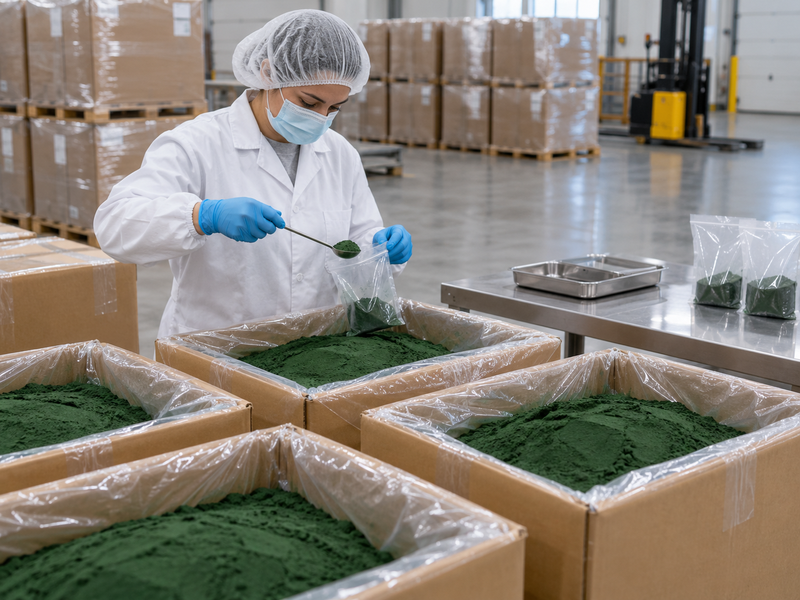
Ask for a simple pack construction drawing or written description, including the closure. Identify the inner bag, any heat seal, tie, adhesive, coating, or insert that can touch spirulina powder during filling, transit, and emptying. A cardboard drum can be the shipping unit while a polyethylene bag is the food-contact article. Conversely, an outer sack may never touch the powder at all. The DoC should be evaluated for the contact article actually used, not for the most visible shipping container.
Request the liner’s commercial code, material structure, thickness or specification range, supplier, and manufacturing site when available. If a multilayer construction is offered, ask which layer contacts food and whether the supplier’s declaration covers the finished construction. Photograph the liner at the filling stage and in an opened arrival unit. This helps the receiving team see whether the delivered package matches the proposed sample, especially when several inner bags have similar appearance.
| Pack component | Contact question | Evidence to request |
|---|---|---|
| Inner bag | Direct, prolonged powder contact? | Liner code and DoC |
| Closure or seal | Can it touch contents? | Construction and suitability statement |
| Outer drum or carton | Is contact prevented by the liner? | Pack drawing and inspection |
2. Who made the liner and which article is declared?
The declaration should identify the business operator issuing it and the material or article it covers. Ask whether the bulk ingredient supplier buys finished bags, forms bags from film, or changes a liner during packing. A film declaration may not clearly describe the converted bag or its seal; have the responsible packaging supplier explain the relationship. The buyer needs a chain from the DoC article name or code to the liner in its purchase order.
Check the document date and revision, and ask whether it remains the version applied to current production. A generic “food grade packaging” letter with no article identifier or issuer leaves too much uncertainty to use as a complete compliance file. If the supplier cannot share proprietary composition, it can still provide the required declaration and arrange for supporting documents to be available to competent authorities as required.
The Commission’s plastics supply-chain guidance explains why information must travel through the chain, while noting that guidance is not a binding interpretation for every fact pattern.
| Identity field | Compare with | Gap to resolve |
|---|---|---|
| Issuing operator | Pack supplier details | Unclear responsibility |
| Article code | Liner specification and order | Different film or bag |
| Revision/date | Current pack production | Obsolete declaration |
3. What must the EU plastic liner declaration identify?
Review the DoC against the information specified by the applicable version of Commission Regulation (EU) No 10/2011, including identities of the issuer and material, date, applicable compliance statements, relevant restrictions, and specifications for use. For a buyer, the most practical fields are which food categories and contact conditions were considered. The paper must be legible, current for the article offered, and consistent with any separate packaging specification.
Do not treat the declaration as a self-contained migration test report. The Commission overview explains that the DoC rests on supporting documentation and that standardized simulants and time/temperature conditions are used to assess migration. Ask who maintains that support and whether the buyer can obtain an appropriate summary or confirmation for its use case.
If a recycled plastic layer, printing, or adhesive is involved, request a specialist review of additional requirements rather than assuming the standard bag declaration covers every component.
| Document element | Buyer check | Follow-up |
|---|---|---|
| Issuer and article | Names/code match liner | Request corrected identification |
| Use restrictions | Food type, time, temperature stated | Compare with planned use |
| Supporting basis | Responsible holder identified | Obtain technical clarification |
4. Does the declared food type fit dry spirulina?
Describe the ingredient as a dry, fine powder rather than accepting “all foods” without review. Check whether the DoC covers dry foods and any relevant fat content or other characteristics used in the liner supplier’s assessment. Powder can settle into seams, so the physical bag design also matters for clean discharge and closure integrity. If the declaration lists exclusions or a particular food simulant, ask the issuer to confirm in writing how the proposed spirulina contact is represented.
The legal assessment uses food-contact categories and migration conditions, not the marketing name of the powder. For example, a declaration intended only for brief contact with dry bakery goods may not necessarily cover months of bulk ingredient storage. Likewise, a specification for packaging already filled with a different food does not establish suitability for this lot. The buyer should send the liner supplier the actual use profile, including powder characteristics, intended pack mass, headspace, and contact duration, then record the reply.
Keep product-safety testing and packaging suitability as separate decisions.
| Proposed use | Ask the issuer | Purchase consequence |
|---|---|---|
| Dry powder contact | Does food category include this product? | Confirm in writing |
| Long bulk storage | Is contact duration covered? | Revise liner or storage plan |
| Hot filling or warm transit | Is temperature covered? | Assess worst case conditions |

5. Do time and temperature cover the shipment?
Create a realistic exposure profile from filling until the inner bag is emptied: filling temperature, warehouse dwell, sea or air freight, customs delay, customer storage, and any warm-season excursion the pack may reasonably experience. Compare this profile with the conditions stated in the DoC or supporting assessment. The Commission’s overview of plastic food-contact rules notes that migration assessment uses standardized time/temperature conditions representative of intended use.
Do not substitute a shipping time estimate for the maximum contact period. A container may spend longer in the buyer’s warehouse than at sea. Ask what happens if arrival is delayed or the powder is repacked after opening. If the declaration covers ambient storage only, a hot-fill or heat-treatment contact requires separate review. The importer and packaging specialist should decide whether the stated test conditions conservatively represent the planned use; the ingredient supplier should not be asked to give a blanket legal guarantee for every route.
| Exposure stage | Record | Compare to declaration |
|---|---|---|
| Filling | Product and liner temperature | Maximum contact temperature |
| Freight | Route and expected excursions | Assessed temperature profile |
| Storage | Maximum planned dwell | Assessed contact duration |
6. How should migration support be reviewed?
Ask the packaging issuer what evidence supports the declared use: migration testing, calculations, screening, or an accepted combination under the applicable rules. A buyer may not receive confidential formulation details, but should be able to obtain a meaningful statement of which article and conditions were evaluated. Check that test conditions relate to the finished liner construction, including layer structure and any relevant additives or restrictions. A bare assertion that “migration passes” is difficult to apply to a different food or storage profile.
The EU food-contact framework calls for materials to avoid harmful transfer and unacceptable changes to food composition, taste, or odour. This is broader than a single numerical migration test. Inspect a pilot-packed powder for odor pickup, visible liner damage, seal failure, and powder caking during storage. Those are product-performance checks, not substitutes for legal migration evidence.
If the packaging supplier offers only a generic film test while the final bag has inks or seams, request a technical explanation of how those features were covered.
| Evidence type | Useful question | Limitation |
|---|---|---|
| Migration summary | Which article and conditions? | May not cover this liner |
| Calculation or screening | What assumptions were used? | Depends on input accuracy |
| Pilot pack trial | Odor, integrity, handling? | Does not prove legal migration compliance |

7. Can the supplied liner be tied to the DoC?
Make the packaging specification part of the ingredient purchase order: liner code, material description, acceptable supplier or equivalent approval process, pack size, closure, and required documents. Ask for a pack bill of materials or controlled specification reference that connects each shipped unit to the liner in the declaration. An invoice for green powder alone will not show which inner bag was used. Request a change-control notification if the packing site replaces the liner supplier or changes the film construction.
At goods receipt, check a representative sample of packages against the approved drawing and photos. Record visible differences, damaged seals, or unmarked substitute bags before opening the entire shipment. If a discrepancy appears, segregate affected units and seek the supplier’s packaging traceability record. The purpose is not to print private formulation data on the drum; it is to preserve a credible trail from declaration to material used. This is especially important when a supplier has several grades of liner for different customers.
8. What changes require a fresh review?
Reassess when the film resin, additive package, recycled content, coating, printing, converter, seal design, or contact layer changes. A new pack size or longer storage period can also change the relevant contact conditions. Ask the packaging supplier to state which changes trigger a revised DoC under its control system. The ingredient buyer should specify that substitutions need notice before shipment, not after a pack arrives at the EU warehouse.
Keep an approved version of the DoC and pack specification with an effective date. When a new revision arrives, compare the old and new use conditions rather than simply replacing the file. If the declaration cites regulations or amendments that have changed, have a packaging specialist assess whether the existing declaration remains appropriate at the shipment date. A regulatory citation alone does not establish that a particular bag remains unchanged.
This step makes the EU plastic liner review a maintained purchasing control rather than a one-time email attachment.
| Change | Buyer question | Decision |
|---|---|---|
| New film or contact layer | Is use assessment still valid? | Hold substitution for review |
| New storage profile | Do contact conditions still cover it? | Seek updated confirmation |
| New declaration revision | What materially changed? | Update approved pack record |

9. How do you handle an incomplete file?
Classify the missing piece instead of issuing a vague rejection. If the document does not identify the article, request a corrected DoC. When use conditions are missing, send the actual time/temperature and food profile to the issuer. If the supplier cannot identify which liner was packed, ask for traceability to the packing batch. A statement that an outer drum is “food grade” does not cure uncertainty about the inner plastic bag.
Use a conditional approval only if the buyer’s own procedure allows it and the missing evidence is clearly resolved before use or import. Do not imply that a supplier email by itself replaces the required declaration. Where the line is urgent, an already approved alternative liner or different pack format may be quicker than reconstructing an incomplete file. Record the decision and owner for each gap. This allows procurement to compare a competitive price with the real cost of qualification work, delays, and possible repacking.
| Missing item | Ask for | Until received |
|---|---|---|
| DoC absent | Current article-specific DoC | Hold pack approval |
| Use not covered | Issuer’s updated assessment | Revise use or liner |
| Shipment identity unclear | Packing traceability | Segregate affected units |
10. What release record belongs with the order?
File the liner drawing or specification, current DoC, supporting explanation of applicable contact conditions, purchase-order pack code, supplier change-control agreement, and receiving inspection result under the shipment and lot identifiers. Record who reviewed the evidence and on which date. This should sit beside, but remain distinct from, the ingredient’s COA and product-safety documents. A well-controlled algae lot can still have an undocumented food-contact liner.
Before a repeat order, verify that the same liner specification and use profile still apply. Ask the supplier to identify any planned packaging change and obtain revised evidence before accepting an equivalent substitute. For a new EU destination or downstream repacking process, revisit the assumptions. The result is a practical purchase rule: the powder’s commercial and technical fit can be assessed with its own sample and COA, while the inner liner has its own traceable, use-specific food-contact file.
FAQ
Q1. Is “food grade plastic” enough for an EU bulk liner? It is too general for this purchasing check. Identify the actual article and review its current DoC and intended-use conditions.
Q2. Does the outer drum’s certificate cover the inner bag? Only if the documentation expressly covers the actual contact article. Check each relevant component.
Q3. Must every buyer receive confidential migration test details? Supporting documentation may be held by the responsible business operator, but the buyer needs enough declared information to evaluate its proposed use.
Q4. Does a DoC guarantee suitability for every shipment route? No. Compare the declared food type and contact conditions with the real route and storage period.
Q5. When should a liner change be notified? Before shipment, so the buyer can review the replacement and update its approved packaging file.
For an EU bulk order, contact SpirulinaCN with the application, target powder specification, anticipated quantity, destination, pack size, and intended storage and transit conditions. Request a lot-matched sample, technical sheet, current COA, liner identification and current DoC, plus an application-specific quotation.