
Spirulina phycocyanin is often discussed as though it were a fixed percentage inside every green powder. It is not that simple. Source culture, harvesting, drying, extraction, and test method all affect what a buyer can measure and use. A blue extract and whole green spirulina may begin with the same cultivated organism but answer different product briefs. This guide shows procurement and R&D teams how to specify each material without confusing a pigment claim with the full biomass.
1. What is the relationship between spirulina and phycocyanin?
Start with the organism and its pigment system
Spirulina is a common commercial name for cultivated cyanobacterial biomass. Phycocyanin is one of the colored proteins associated with its light-harvesting machinery. The two terms describe different levels of the same supply chain: a whole organism and a component recovered from it. A review of phycobiliproteins explains where phycocyanin sits among related pigment proteins and why its spectral behavior matters.
This distinction prevents a common purchasing error. A whole green spirulina powder includes much more than its blue pigment fraction. A blue phycocyanin-rich extract has undergone processing that changes the composition and appearance. The buyer should identify which one the recipe needs before sending a price request. If a supplier quotes both, ask for separate specifications, ingredient statements, and batch COAs. A claim that one automatically replaces the other ignores color, flavor, protein composition, and process performance in the finished product.
2. Why does whole spirulina look green while the extract looks blue?
Different fractions dominate the visual result
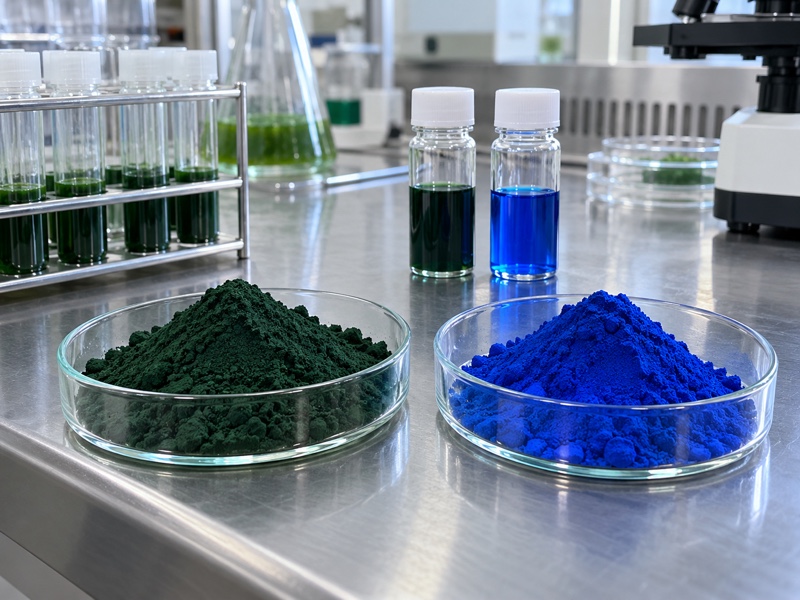
Whole biomass contains green chlorophyll and other colored compounds as well as phycocyanin. Its dry powder therefore usually appears dark green. An extraction process can recover more of the water-soluble blue fraction and leave behind much of the green biomass. The result may be sold as blue spirulina or phycocyanin extract. Those market names should lead to a composition question, not end it.
Set up a simple side-by-side test with equal known weights in the target formula. Whole spirulina may contribute green color, algal flavor, and suspended material. A blue extract can produce a different shade and dispersion. Do not judge only from dry powder photographs; a bright powder may behave differently when mixed into an acidic drink or opaque yogurt. Record dilution, pH, hold time, and lighting conditions. If the blue product includes a carrier, account for that on the label and in the cost calculation. The finished-food trial is where the distinction becomes commercially useful.
| Material | Typical visual role | Procurement question |
|---|---|---|
| Whole spirulina biomass | Green whole-algae ingredient | Which species, lot, and nutrient basis? |
| Blue extract | Blue pigment contribution | What is the full composition and assay? |
| Finished blend | Formula-specific effect | Which carriers and use level? |
3. How much phycocyanin is in a spirulina lot?
A reported value needs a method and basis
The amount can vary by culture and processing conditions, but a buyer should not copy a range from a review into a supplier specification. Ask for the actual lot result and its analytical method. Was phycocyanin measured after extraction from dried biomass, in a wet sample, or in a formulated powder? Are values on a dry-matter or as-sold basis? Did the laboratory correct for overlapping pigment signals? These details affect comparability.
If a project depends on a declared phycocyanin content, define the sample preparation and calculation in the contract. Use a common laboratory method to compare suppliers. Retain a reference sample and request multiple production lots so ordinary variation can be distinguished from a changed process. A review of phycocyanin production describes how cultivation and downstream methods influence the material. That literature is a reason to measure the delivered lot, not a substitute for measuring it. Price per kilogram tells little when the assay basis differs.
4. What happens during extraction?
Recovery, clarification, and drying each change the material
Processors first obtain spirulina biomass, then release the water-soluble pigment proteins by a chosen cell-disruption method. Clarification removes unwanted solids; concentration and drying turn the extract into a form suitable for shipping and formulation. A review focused on Limnospira extraction describes multiple techniques and their trade-offs. Commercial processes vary, and a supplier need not reveal confidential settings to provide a useful process overview.
Ask what kind of extraction is used, which processing aids may remain, and whether the finished powder has carriers. For food use, the method should be compatible with the intended market and support the required safety package. A highly concentrated laboratory fraction is not necessarily the most practical ingredient. It may be harder to handle, less stable, or more expensive per acceptable finished unit. Compare clear specifications and real application trials instead of assuming that the longest purification flow delivers the best product.
| Process stage | Buyer focus | Relevant record |
|---|---|---|
| Biomass intake | Identity and contaminant controls | Incoming lot record |
| Cell disruption | Repeatable release | Batch process record |
| Clarification | Solids and shade | In-process checks |
| Drying/blending | Carrier and moisture | Finished specification |
5. When should a brand choose whole spirulina?
Use it when the whole-algae profile fits the product
Whole green spirulina may suit a product that intentionally presents an algae ingredient and accepts its color and flavor. Examples include green nutrition powders, tablets, or blends where the biomass itself is the feature. The exact nutrient and pigment composition still needs a current technical sheet and lot data. A published average should never be copied onto a product label as though every shipment meets it.
Test the actual powder in the intended format. A tablet team should evaluate flow, compression, and disintegration. A drink-powder team should check dispersibility, visible particles, flavor, and sediment. For a green smoothie powder, the color may be welcome; for a transparent blue beverage, it may fail immediately. Discuss whether the supplier offers both powder and tablets, and do not assume a blue extract is sold in those same forms. The current catalog lists whole spirulina as powder and tablets, while the blue phycocyanin range is powder. State the distinction clearly in an RFQ to avoid mismatched quotes.
6. When should a formulator choose the blue fraction?
Specify the color task and processing limits
The blue fraction is often chosen when a product needs a blue shade without the dark-green appearance of whole biomass. Begin with target color, base formulation, use level, processing temperature, pH, package, and desired shelf life. A supplier can then suggest a sample grade for testing. The color should be assessed after full manufacturing, not only in a beaker of water. The food-industry review of phycobiliproteins discusses the opportunities and limits of these protein-based colors.
The blue powder may have different dispersibility and sensory impact from whole spirulina. Record the accepted dose and calculate cost in a finished unit. If several grades from the same supplier are available, test them under the same conditions. E3, E6, E18, E25, E35, and E40 are catalog codes, not self-explanatory purity or color guarantees. Their actual specifications and batch COAs must guide selection. A more intense sample may cost more but need less material, or it may not survive the process as well. The trial resolves that question.
| Product brief | Likely starting material | Confirmation test |
|---|---|---|
| Green whole-algae tablet | Whole spirulina | Compression and assay |
| Bright blue cold drink | Blue extract | Shade and storage |
| Opaque nutrition shake | Both possible | Flavor, color, texture |
| Clear blue confection | Blue extract | Heat and pH trial |
7. How should a buyer compare supplier claims?
Put every claim beside its evidence
Ask each supplier for the same set of documents: material identity, origin, composition, processing overview, specification, recent batch COA, safety tests, and sample from commercial production. Check whether a “phycocyanin percentage” refers to whole biomass or extract. Check whether a color value is based on a defined dilution and wavelength. If a brochure lists certifications, ask for current certificates and scope covering the actual manufacturing site and product category.
Do not make a purchasing decision from one headline figure. A whole spirulina supplier might report protein on a dry basis, while an extract supplier reports color value per gram as sold. They are different measures. Build a comparison sheet with one row per product form and one column per defined unit. Use an independent laboratory when a critical result is difficult to compare. Note which claims are verified, pending, or unsupported. That discipline also makes supplier conversations more direct: you can ask for the missing method instead of debating whose adjective sounds stronger.
8. What safety and regulatory questions follow the source?
Follow the exact material into the destination market
The source and cultivation environment shape the safety review. The FDA’s guidance on microcystins in blue-green algae products makes contaminant testing a concrete question. Request results tied to the offered lot, plus microbiological and elemental tests appropriate to the product. Ask how raw biomass is approved and how changes in cultivation source are handled. A blue extraction step does not automatically erase every upstream concern.
The regulatory analysis should identify the product form and intended use. The United States has a specific listing for spirulina extract as a color additive, with conditions set by the regulation. Whole biomass, a blue extract used as color, and an ingredient used in a supplement may require different assessments. Have local specialists check the exact material and market. A statement that a supplier exports worldwide is not proof that every formulation and claim is permitted everywhere.
| Question | Whole biomass | Blue extract |
|---|---|---|
| Source traceability | Cultivation to dry powder | Cultivation through extraction |
| Composition | Whole-algae profile | Pigment plus other ingredients |
| Intended use | Nutrition/formulation | Often color/formulation |
| Legal review | Product and market specific | Product, use and market specific |
9. How do you measure performance in a finished product?
Set acceptance limits before the pilot
Write down the target shade or nutrient result, sensory limits, processing conditions, and shelf-life endpoint. Use measured doses and a retained reference material. For a blue drink, check pH and color before and after the production process. For a whole-spirulina tablet, check dose uniformity and physical performance. For either material, compare the first commercial lot with the approved pilot sample. A supplier’s bench result may not predict a factory run if mixing order or heat exposure changes.
The measurement plan should be short enough to repeat. Color photographs need standard lighting, or they can mislead. Assay values need the same method and sample preparation. A sensory panel should use the same recipe and serving temperature. Record deviations immediately. If a result fails, decide whether the problem comes from the ingredient, the formula, or the process. This is easier when the team kept a retained sample from both the ingredient lot and the finished pilot batch.
10. What should the purchase specification say?
Write for the product you will receive
Name the material unambiguously: whole spirulina powder, whole spirulina tablet, or a defined phycocyanin-rich extract powder. Add the source, full ingredient composition, packaging, storage instructions, acceptance methods, critical quality limits, and required batch documents. State the approved application and any change-notification requirements. Include a dispute procedure that identifies the referee method and laboratory. A one-line order for “spirulina phycocyanin” leaves too much interpretation to a future sales conversation.
The first commercial shipment should match an approved sample under the same test conditions. Review its COA before release, then confirm the finished-product performance. If a later lot changes shade, the team should be able to trace the biomass, process, and test data. That traceability is useful whether the ingredient is green biomass or blue extract. It turns a vague category name into a repeatable supply decision.
| Specification field | Whole spirulina | Blue extract |
|---|---|---|
| Material name | Whole biomass form | Extract form and carrier |
| Identity | Species and lot | Species, lot, process |
| Critical result | Agreed nutrient/pigment tests | Agreed color/assay tests |
| Application | Approved product format | Approved matrix and shade |
| Change control | Biomass/process changes | Biomass/extraction/blend changes |
The chlorophyll comparison explains another practical difference between whole biomass and blue extract.
FAQ
Q1: Is phycocyanin present in whole spirulina? Yes, but the amount and measured result depend on the source lot and method.
Q2: Does blue spirulina mean whole spirulina? Usually the term points to a blue extract. Ask for the actual composition and process description.
Q3: Can an E-grade name tell me the pigment percentage? No. Read that grade’s current specification and lot COA.
Q4: Which form costs less in a recipe? Compare cost per acceptable finished unit after dose, processing, sensory, and waste are measured.
Q5: What is the first question for a supplier? Ask whether the offered product is whole biomass or an extract, then request the matching technical and safety documents.