
A private label spirulina supplements checklist prevents a familiar launch problem: packaging is approved while the dose, ingredient lot or manufacturer process still changes. Move through explicit gates for product brief, sourcing, formula, pilot, claims and release. US dietary supplement CGMP guidance provides a strong records framework for US products; other markets need their own rules and review.
Contents: 1 · 2 · 3 · 4 · 5 · 6 · 7 · 8 · 9 · 10
1. What exactly is the private-label product?
Write a one-page product brief
Define intended consumer, market, daily serving, form, count, package, price position and launch channel. State whether the product uses whole green spirulina biomass, a blend or a different extract. Those materials cannot be substituted without changing the formula and possibly the label. Decide whether the manufacturer will use an existing validated base formula or develop a custom one. Ask which decisions remain open and who owns them.
Keep proposed claims in a separate column marked pending until regulatory review. A desired phrase can affect ingredient level and testing, so it belongs in the brief but should not be printed yet. Identify countries of sale; an artwork file for one market may be wrong in another. For US products, FDA describes the definition and required statements for a dietary supplement label. The starting gate: no supplier quote is comparable until everyone is quoting the same product.

2. How should the ingredient be qualified?
Tie a sample to a current commercial lot
Request identity, cultivation or source details, physical grade, composition, contaminant specification, COA, method information and lot traceability. Whole spirulina can vary in moisture, particle size, density, odor and color. A polished sample may not represent the bulk grade that production will receive. Ask for current commercial-lot samples and keep an approved retain. FDA discusses microcystins in blue-green algae products, making method and sampling questions relevant to an ingredient review.
Review metals, microbiology and any other hazards based on source and destination. A COA pass is one piece of a supplier qualification program, not proof of every claimed attribute. Ask whether the ingredient site or drying process may change and how the supplier would notify your manufacturer. For US dietary supplements, component identity and other specifications are addressed in 21 CFR 111.70. The useful purchasing rule: approve a documented material range, not a single anonymous green powder sample.
| Ingredient file | Ask for | Why |
|---|---|---|
| Identity | Method and lot link | Avoid substitution |
| Contaminants | Analytes and methods | Interpret risk |
| Physical grade | Size, density, moisture | Predict processing |
| Traceability | Source through pack | Support recall and repeat orders |
3. Which dosage form fits the intended serving?
Compare tablets, capsules and powder honestly
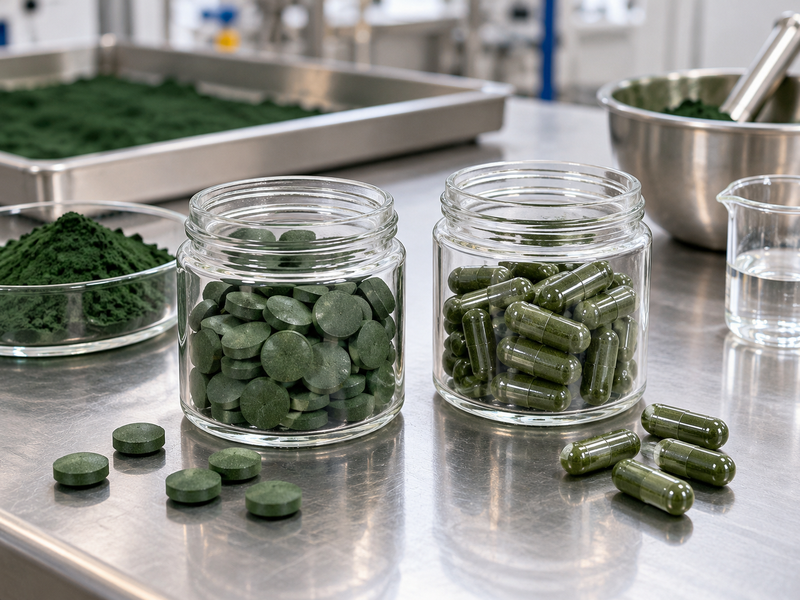
Set a daily spirulina amount and then calculate unit count and actual ingredient content. Tablets may use binders or other aids; capsules include a shell; powder sticks need fill and seal controls. Ask a manufacturer for representative samples made from the same ingredient lot. Check swallowing, taste, preparation and package size with intended users. A seemingly cheap tablet can require too many units per day, while a convenient stick can require more packaging and flavor work.
Inspect formulation and process needs before committing to artwork. A spirulina-containing tablet study measured physical properties for its test formulas, illustrating why actual unit testing matters. For capsule work, record net fill separately from shell mass. For a powder, test the prepared serving. The format gate: dose, customer handling, line capability and final cost per serving must all pass.
4. What should the manufacturing agreement specify?
Assign work and release authority
List who buys each component, qualifies suppliers, approves formulas, owns tooling, performs testing, reviews labels, releases lots and handles complaints or recalls. Define minimum run, expected yield, change notification and responsibility for unused printed material. A quote that omits testing or rejects may look attractive but shift work to the brand after purchase. Request the manufacturer’s process flow and relevant quality-system scope for the intended market.
For US dietary supplements, the FDA CGMP guide explains master manufacturing records, batch production records, specifications and quality-control operations. A outside logo alone does not replace those records. Review a sample redacted batch record before signing. The useful contract outcome: each critical step has one accountable owner and an agreed document that shows completion.
| Activity | Brand decision | Manufacturer evidence |
|---|---|---|
| Formula | Approve target | Quantitative master record |
| Components | Approve supplier range | Receipt and release checks |
| Testing | Approve plan | Results and disposition |
| Recall | Agree response | Traceability exercise |
5. What belongs in the product dossier?
Assemble evidence before the pilot
Keep the product brief, ingredient specifications, source and allergen declarations, formula, component list, pack specification, test methods, stability plan and claim rationale in a controlled folder. Every item should have a version, owner and date. If a capsule shell, color or tablet aid changes, review labels and test plans. If a distributor supplies spirulina, retain the manufacturer lot identity through the chain.
Avoid accepting a generic “certificate pack” without checking whether it applies to the precise product, site and lot. Request current documentation and identify gaps. A dossier is useful only if operations can use it to make the same product and quality can use it to judge release. A sales page may describe a supplier’s capability, but the buyer must verify present batch documents. The handoff question: could a new project manager reconstruct the approved SKU without asking which email contained the latest formula?

6. How should the pilot be designed?
Produce market-like units and packs
Use the intended ingredient grade, quantitative formula, manufacturing line and package materials. A small hand-made sample can screen taste but cannot demonstrate line yield or unit consistency. Define acceptance criteria in advance: dose, weight distribution, physical integrity, microbiology, pack seal and any relevant assay. Sample startup, running and end-of-batch material. Record settings, deviations, rejects and rework.
Make enough pilot units for user handling, label proofing, transport and stability studies. If the manufacturer must substitute a component, document the change and decide whether results remain relevant. A pilot that “looks good” without batch data should trigger a further trial, not a production order. Under US 21 CFR 111.260, batch records include component use, yields, monitoring, testing and quality decisions. The pilot deliverable: a finished product and the records explaining how it was made.
| Pilot sample | Why keep it | Review point |
|---|---|---|
| Startup units | Setup variation | Unit tests |
| Running units | Normal process | Trend and yield |
| End units | Drift | Final consistency |
| Packed retains | Market life | Stability |
7. When should artwork and claims be approved?
After formula and serving are stable
Check product name, serving size, ingredient amounts, ingredient list, allergens, net quantity, directions, lot and date coding and responsible-business information. For US supplements, FDA nutrition-label guidance explains serving-size and Supplement Facts rules. Other countries may require different structure or language. Claims need separate evidence and legal review; an ingredient brochure does not authorize a finished-product promise.
Print a physical proof on the chosen bottle or carton. Check readability, barcode, tamper feature and label placement. Cross-check the approved formula and pilot pack count. A change from two tablets to three per serving affects declarations and days of supply. A new excipient affects the ingredient list. The artwork gate: regulatory and quality staff sign the same final file that the printer receives.

8. How should shelf life and packaging be approved?
Test the finished SKU in its package
Study the actual tablets, capsules or powder in the proposed bottle, blister or stick pack. Track relevant physical, sensory, microbial and composition attributes. Include packaging integrity and realistic distribution conditions. A desiccant choice or bottle change can alter the product’s environment; neither should be treated as cosmetic. Accelerated data can help screen options, but a printed expiry needs suitable product-specific support.
Ask who owns the stability protocol and who reviews each time point. Keep retained samples linked to manufacturing and packaging lots. If a supplier proposes a standard shelf life from another product, request its relevance to this formula, dose and pack. FDA notes that food-contact material status depends on actual conditions of use. The approval question: will the product still meet its signed specification when it reaches the end of labeled life?
| Pack decision | Evidence | Change impact |
|---|---|---|
| Bottle or blister | Finished-unit stability | Repeat relevant study |
| Closure | Integrity test | Recheck moisture protection |
| Desiccant | Product response | Reassess handling and label |
| Count | Pack validation | Recheck days of supply |
9. What must happen before commercial release?
Reconcile batch, pack and label
Quality personnel should review ingredient release, production records, deviations, in-process checks, finished-product tests, packaging reconciliation and label version. Hold product until required approvals are complete. Verify lot code links all finished packs to the ingredient and packaging lots. Conduct a traceability exercise on a pilot or early commercial lot, then fix any broken link before distribution.
The brand should receive a defined release pack rather than a bare COA: finished lot identity, signed test status, packaging information and outstanding deviation disposition. FDA’s Part 111 guide places quality-control review within supplement production. The release standard: a marketing launch date cannot substitute for a documented quality decision.

10. How can repeat orders remain consistent?
Build change control into supply
Agree on notification for new spirulina source, cultivation site, drying route, powder mesh, excipient grade, shell supplier, tooling or packaging component. Define which changes need a comparability trial, updated label or renewed stability work. Keep an approved retain and review early repeat lots against it using objective and sensory checks. Monitor complaints by lot and feed findings into supplier review.
Reorder from the signed master formula and artwork, not a previous purchase-order description alone. Compare supplier performance using release yield, deviations, complaint trends and document timeliness. If a site states that it can private-label many formulas, treat that as its claim until its current line, quality records and capacity are verified. The next move: hold a short launch handoff with product, quality, regulatory and manufacturer owners so each has the same approved version.
| Change | Review needed | Possible test |
|---|---|---|
| Spirulina lot range | Processing and specification | Pilot comparison |
| Dosage component | Formula and label | Unit and stability tests |
| Pack material | Contact and barrier | Integrity and shelf study |
| Claim | Market and evidence | Regulatory sign-off |
Review a shell change before reordering
Consider a brand ready to reorder capsules. The manufacturer proposes another shell because its usual supplier has a delay. Spirulina fill stays the same, but the shell may change total unit weight, machine setup, ingredient declarations and packed stability. Ask for the new shell specification and run a fill and closure comparison. Check the label and decide whether earlier stability results still apply.
Procurement can then compare the delay with the cost of qualifying a substitute. Quietly using the new shell under the old product code would make later complaints harder to investigate. The same review applies to a new spirulina mesh grade or bottle closure. Each change needs an owner, evidence and an approved path back into production.
Keep a decision log with the reason for each change, the evidence reviewed and the final approver. Link that log to the affected lot codes and artwork version. If a customer later asks why capsules from two orders look different, the brand should be able to answer from records rather than memory. A short, consistent review is easier to run than a large investigation after stock has entered distribution.
FAQ
Q1: Is private label the same as buying bulk powder? No. Finished dosage form, packaging, records and labeling add separate responsibilities.
Q2: Can a supplier’s standard COA replace qualification? No. Verify methods, scope, lot history and process controls.
Q3: Should artwork be printed before the pilot? Wait until formula, serving and pack are approved to avoid mismatches.
Q4: Who releases the finished lot? Assign authority in the quality agreement and follow applicable market rules.
Q5: Can a formula change without a new label review? Review every change for ingredient, serving and claim effects.
Next step
Use this private label spirulina supplements checklist as a sequence of signed gates. Define the SKU, qualify the ingredient, prove the pilot, approve artwork and package, then release only on complete records. Ask manufacturers for current lot documents and a clear responsibility map. That gives your brand a repeatable product rather than a one-off sample.