
A tablet can survive freight yet fail to break apart under its agreed test. Chlorella tablet disintegration is the measured breakup of a finished tablet under defined laboratory conditions. Brand buyers need to balance this behavior with hardness, friability and shelf life before approving a manufacturer. The USP dietary supplement chapter <2040> addresses disintegration and dissolution where stated in relevant monographs; it is not a universal claim that every chlorella tablet meets one fixed limit.
Contents
- What does tablet disintegration measure?
- Why can chlorella tablets break up slowly?
- How does compression affect the tradeoff?
- Which formulation choices matter?
- How should a test method be defined?
- What samples should a buyer request?
- How can storage change performance?
- What belongs in a manufacturing control plan?
- How should a failure be investigated?
- How can brand buyers write an acceptance rule?
1. What does tablet disintegration measure?
Define the endpoint before comparing times
Disintegration tests whether a tablet breaks into smaller particles under specified apparatus, medium, temperature and observation rules. It does not directly measure how much of a constituent dissolves, enters the bloodstream or produces a health effect. A chlorella tablet may contain whole biomass that does not dissolve like a purified compound. The buyer should avoid translating a favorable breakup time into an unsupported bioavailability claim. Keep the test’s purpose narrow: confirm that finished units behave consistently under the method chosen for the product.
Start with the label and market. A swallowed dietary supplement, a chewable product and a tablet intended for reconstitution may need different performance expectations. The USP chapter <2040> preview explains its use where an individual monograph states a standard. Check whether a cited compendial method truly applies to the product. If the company uses an internal method, document it completely and justify its acceptance limit with development and stability data. A bare COA line saying “disintegration: pass” hides the conditions needed to interpret the result.
2. Why can chlorella tablets break up slowly?
Look at the whole tablet, not one raw-material number
Chlorella powder properties can vary with cell-wall processing, particle size, moisture and bulk density. Those features influence how particles pack and bond, but finished-tablet behavior also depends on binder, lubricant, disintegrant and compression. A tablet with an acceptable raw chlorella COA can still have a poor breakup profile when pressing conditions change. Ask the contract manufacturer for the actual formulation and process version used in the approved sample.
A common source of confusion: a supplier says its chlorella has a “broken cell wall,” implying the finished tablet must disintegrate quickly. Cell-wall treatment concerns biomass particles. Tablet disintegration concerns the compressed unit. They are different tests. A hard tablet may require enough force to survive coating or shipping, yet excessive force can slow medium penetration. Surface coating may also delay wetting. Ask the manufacturer which factors were examined during development and how it sets operating ranges. Avoid treating one anecdotal glass-of-water demonstration as a validated laboratory method.
| Factor | Possible effect | Review item |
|---|---|---|
| Powder size | Changes packing | Distribution by lot |
| Moisture | Changes bonding | Raw and finished results |
| Binder | Strengthens compact | Formula version |
| Coating | Alters wetting | Coating process record |
3. How does compression affect the tradeoff?
Balance breakup with physical survival
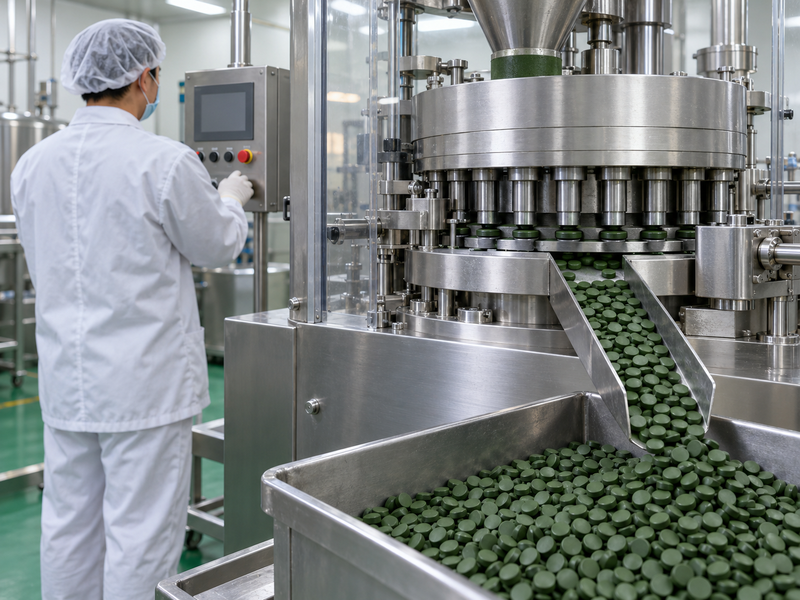
Compression force can increase tablet hardness, reduce porosity and change how quickly fluid penetrates. Too little force may produce friable units that chip in bottles; too much may slow disintegration. The relationship is formulation-specific rather than a universal curve. Record press speed, tooling, fill weight, compression force and in-process hardness or thickness checks. The manufacturer should demonstrate that commercial-scale pressing stays in a range that meets all agreed attributes.
Think about real freight: a tablet that breaks apart quickly in a lab but turns to dust during distribution has not solved the buyer’s problem. Test friability, hardness, appearance and disintegration together. Compare units from the beginning and end of a run, since setup and drift can affect output. If a trial sample was pressed on a benchtop machine, request a commercial-equipment trial before a large order. A COA average can mask variation; review the sampling plan and individual outcomes where the method calls for them. Document rework rules for chipped or out-of-limit tablets rather than blending them back without trace.

4. Which formulation choices matter?
Name every functional ingredient
Binders, disintegrants, lubricants and coatings can all affect breakup. A formulation with only chlorella may behave differently from one with excipients added for consistent pressing. Brand buyers should request the full qualitative and quantitative composition under appropriate confidentiality terms. That review supports ingredient declarations, allergen assessment and technical acceptance. A supplier should not replace one excipient with another while continuing to describe the tablets as the same approved formula.
Watch for a tradeoff: extra lubricant may improve release from the press yet make tablet surfaces harder to wet. More binder may reduce chipped edges yet resist breakup. Neither effect is automatic across every formula; a controlled trial is needed. Compare candidate formulas using the same test conditions and packaging plan. Record target tablet mass and any coating weight separately. If the brand wants a “pure chlorella” claim, confirm what that phrase permits in its destination market and how the manufacturing process achieves workable tablets. Do not let an unapproved aid appear after marketing text has been finalized.
| Ingredient role | Buyer question | Record |
|---|---|---|
| Binder | Is amount controlled? | Formula and batch record |
| Disintegrant | Does it work over shelf life? | Trial and stability data |
| Lubricant | Does level affect wetting? | Mix time and percentage |
| Coating | Is breakup still acceptable? | Coating and test results |
5. How should a test method be defined?
Make two laboratories able to repeat it
Write the apparatus, medium, volume, temperature, number of units, endpoint and reporting format. Say whether tablets are coated and whether any special preparation is allowed. Use a compendial method only when the product and cited standard support that choice; otherwise validate an internal method for its intended purpose. Include a procedure for units that float, stick to equipment or leave a residue. A laboratory must know whether the endpoint requires disappearance of a whole core or merely loss of a firm structure.
Ask for raw observations. A single “pass” entry may hide a borderline unit or an operator judgment. The test should state how individual results and retests are handled. If the manufacturer and buyer use different methods, compare them on matched samples before a dispute arises. The USP chapter <2040> offers a recognized reference within its stated scope. Its existence alone does not set a limit for every chlorella tablet. Keep specification language tied to the exact method revision and product version approved by the brand.

6. What samples should a buyer request?
Include production and shelf-life conditions
Request pilot and commercial-scale tablets made with the intended chlorella grade, formulation, equipment and package. Ask for units from across the press run and from different bulk containers if material was blended. Keep retain samples under documented storage. A hand-made sales sample may look excellent yet fail to represent regular production. Compare several manufacturing lots if the supplier’s process history is limited. The buyer’s acceptance decision should reflect expected variation, not a single ideal tray.
For a new program, use the final bottle or pouch with its planned closure. The pack matters: moisture uptake can change tablet strength and breakup. Review results at release and during a justified stability program. If a supplier proposes a substitute chlorella powder midway through the program, repeat relevant tests before approval. Keep sample identifiers, formula versions and lot codes linked to every result. A brand that receives anonymous loose tablets cannot verify whether the next commercial shipment came from the process it approved.
| Sample | Purpose | Evidence to keep |
|---|---|---|
| Pilot | Screen formula | Process and formula |
| Commercial start/end | Check run variation | Press and test records |
| Packaged retain | Check aging | Storage and timing |
| Changed raw lot | Check source effect | Raw and finished results |
7. How can storage change performance?
Test the tablet in its selling package
Powder and finished tablets can exchange moisture with their surroundings. A tablet might harden, soften, crack or change disintegration behavior during storage. The direction depends on formula, coating and package; do not assume all chlorella tablets behave alike. Choose stability conditions and test intervals based on the intended market and shelf-life claim. Record packaging material, closure, lot and storage environment. A bare tablet in a laboratory dish does not represent a sealed retail bottle.
A buyer should compare time points. A release result that meets the limit cannot guarantee performance months later. Include appearance, hardness, friability and the agreed disintegration method in a stability plan where relevant. Inspect closures after transport and confirm whether a desiccant is part of the approved pack. If tablets are repacked by a distributor, assess whether that new packaging changes the evidence. Supplier shelf-life statements should be supported by the actual formulation and pack offered, rather than borrowed from a related green tablet.

8. What belongs in a manufacturing control plan?
Connect raw powder, press and finished release
The plan should define raw chlorella grade, composition, blend controls, granulation if used, press settings, in-process checks and finished-product specifications. Set action rules for hardness or thickness drift before the run starts. Record cleaning, line clearance and changeovers. A supplier should show how it prevents a late press adjustment from creating a mixed batch with different breakup behavior. Separate development trials from approved commercial instructions.
For U.S. dietary supplements, the FDA dietary supplement CGMP rule sets applicable requirements for components, production records and product specifications. The brand and manufacturer should determine their respective duties. A practical review: pick a released bottle, then identify its raw powder lots, blend batch, press run, package lot and disintegration result. A process-control plan is only useful if those records connect. If the supplier tests only a beginning sample, ask how it detects late-run drift. If it rejects units, verify that rejected tablets are reconciled and do not reenter saleable inventory.
| Control point | Routine check | Response |
|---|---|---|
| Raw powder | Grade and identity | Hold mismatch |
| Blend | Composition and uniformity | Investigate drift |
| Press | Hardness, weight, appearance | Adjust or hold |
| Finished lot | Defined breakup test | Quality disposition |
9. How should a failure be investigated?
Hold the lot and compare it with a passing one
Record the actual failing observations, test apparatus status, sample identity and method revision. Confirm whether a laboratory error is plausible under the approved investigation procedure. Then compare raw chlorella, excipient lots, blend time, press settings, hardness, coating and pack data with a passing lot. Do not treat a favorable retest as proof the original result was meaningless. Find the affected time window and identify any already shipped stock.
Look for linked changes: a new powder particle-size profile and higher compression force might both contribute. An investigation that blames only one without evidence may invite recurrence. Decide whether reworking tablets is permitted, technically sound and traceable. Document product disposition, customer notification and corrective action. If a failure appears during stability rather than release, assess lots still in distribution as well as stock at the plant. Confirm that a later commercial run meets the corrected process before closing the issue. The buyer needs a concise technical report, not a promise that staff will “be more careful.”

10. How can brand buyers write an acceptance rule?
Put method and product version on the purchase document
The specification should state the agreed disintegration method and limit, units sampled, retest policy, formula version, package and shelf-life expectation. Add hardness, friability and appearance criteria so speed of breakup is not optimized at the expense of shipping durability. Reference the approved chlorella grade and supplier-change process. A headline claim such as “quick release” needs separate regulatory and substantiation review; a routine laboratory result does not authorize it.
Make approval conditional on real production: a pilot result can justify a commercial trial, while a production lot and stability evidence support continuing supply. Agree who receives deviation notices and who can release a held lot. Ask for a sample COA before the purchase order is signed to see whether it reports methods and actual results. Chlorella tablet disintegration then becomes one controlled performance attribute among several, with a meaningful test and a clear owner. That protects both the brand’s manufacturing schedule and customers who expect consistent tablets.
| Contract item | Wording to define | Buyer owner |
|---|---|---|
| Test | Method and revision | Quality |
| Limit | Justified acceptance | R&D and quality |
| Package | Exact commercial format | Packaging |
| Change | Prior notice and trial | Supplier quality |
FAQ
Q1. Is disintegration the same as dissolution? No. Breakup of a tablet and dissolution of constituents answer different laboratory questions.
Q2. Does cell-wall disruption prove faster tablet breakup? No. Finished-tablet formulation and compression still need testing.
Q3. Is there one universal time limit for all chlorella tablets? No. Use a standard that truly applies or justify a product-specific limit under a defined method.
Q4. Why test after storage? Moisture and package behavior can change a tablet after its release test.
Q5. Should a buyer accept a COA that says only “pass”? Request the method, criterion, lot and actual results or another agreed reporting format.
Chlorella tablet disintegration should be judged alongside strength, formula and pack stability. Ask a manufacturer for matched commercial samples, a complete test method and a record of press conditions before approving supply. That evidence supports a consistent product without making unsupported absorption claims. Read the USP <2040> overview for the chapter’s stated scope.