
A perfect sample can become useless when nobody can prove which lot it came from or who opened it. China blue spirulina wholesale sealed samples give buyer and supplier a shared reference for quality discussions and later complaints. This guide sets out a joint sampling, sealing and retention chain from a China production site to the buyer. It also shows where a reference sample helps and where new testing remains necessary. ISO/IEC 17025:2017 supports competent laboratory work; custody and contract rules must still be designed for the actual transaction.
Contents
- What job should a sealed sample perform?
- Which samples should both sides retain?
- When should the commercial lot be sampled?
- How should portions be split and identified?
- What belongs on each seal and label?
- How should custody be recorded?
- Where and how should retains be stored?
- When may a sealed sample be opened?
- How should a complaint use the reference set?
- What should the contract say about retention?
1. What job should a sealed sample perform?
Choose the question it can answer
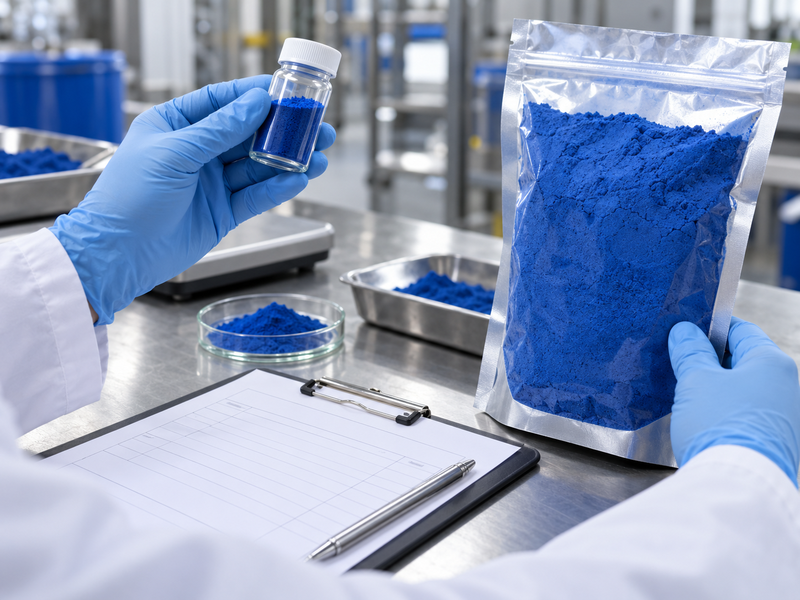
A sealed sample preserves a known portion of a named lot at a known point in time. It can support comparison of color, odor, composition or packaging identity later. It cannot prove that every carton matched that portion, and it cannot replace a fresh sample from a disputed shipment. Define whether the set serves as an approved commercial reference, a laboratory split, a dispute retain or all three. Separate those functions in labels and records. An early sales sample may help choose a shade; a production-lot retain helps investigate what actually shipped.
Here is the practical distinction. If a buyer says delivered powder looks different, compare the arrival sample with a protected lot retain. If a laboratory result differs, test an unopened split from the original draw. If a pouch leaks in transit, a powder retain alone will not show whether the seal design was adequate; keep packaging evidence too. These examples call for different containers and sample sizes. Agree the purpose before anyone fills jars. Otherwise a sample may exist yet answer the wrong question when a complaint arrives.
2. Which samples should both sides retain?
Build a matched, limited set
A useful set may include a supplier retain, a buyer retain and a protected laboratory dispute portion from the same documented draw. If the contract names a referee lab, keep enough material for the specified methods and any agreed confirmation. Store a separate commercial reference if it represents an earlier approved target rather than the finished lot. Label each role clearly. The number of portions depends on test volume, shelf life and dispute design; a universal jar size would be misleading.
Think through an order change. A single order containing two manufacturing lots needs distinct reference sets. A repacked lot may need a pack-stage sample as well as source-lot history. A blend made from multiple lots needs a record that links incoming material to the finished batch. Do not pool them into one unlabeled blue powder jar. Ask the laboratory about minimum mass and container compatibility before splitting. A sample too small for confirmation will disappoint both parties exactly when evidence matters most. The buyer and factory should hold matching identifiers even if they keep different portions.
| Portion | Typical custodian | Main use |
|---|---|---|
| Production-lot supplier retain | Factory quality | Internal investigation |
| Buyer retain | Buyer quality | Arrival or complaint comparison |
| Protected dispute split | Agreed independent custodian | Referee testing |
| Approved development reference | Buyer and supplier | Target shade or application trial |
3. When should the commercial lot be sampled?
Draw after the lot boundary is stable
Sample after blending, drying and packing decisions have created an identified finished lot, unless a specific in-process question calls for an earlier draw. Record whether the sample came from sealed saleable units, a controlled bulk vessel or a packing-line outlet. These sources are not interchangeable. If final bags contain a different carrier blend or received additional handling, an earlier sample may not represent them. Link the event to the lot release record and carton list. If the buyer pays for an independent draw, the sampler should select units under a written plan.
A simple timing test: could the factory still add material to the lot after sample collection? If yes, either freeze the population or document how later additions will be represented. A seller may offer a jar from its retained archive; that can be informative but does not provide the same independence as drawing from selected commercial packs. A shipment that uses two packaging dates may also require attention to both groups. The objective is a defensible link between reference and shipped goods. Record deviations openly rather than trying to make every sampling event look identical.

4. How should portions be split and identified?
Divide one documented draw consistently
Write a split procedure that names the sampler, hygiene controls, tools, container type, portion mass and sequence. If combining material from multiple selected units, record which units contributed and why compositing suits the intended tests. Homogenize only when the method permits it; aggressive handling could alter a color-sensitive product. Use clean, dry tools and containers compatible with analytical needs. The supplier and buyer can witness filling and sealing in person or through a recorded, agreed process. Witnessing proves an event was observed, not that the sample represents every unit.
Keep identity simple. Give the draw one event ID and each portion a suffix. The worksheet should map event ID to product, specification revision, manufacturing lot, selected package IDs and sealing time. Photograph the filled portions together before they leave the table. Never reuse an ID after a broken container or failed seal; issue a replacement with a cross-reference. If a third-party sampler controls the draw, have that party keep its original worksheet. A later analyst should be able to read the label and find the underlying event without calling a salesperson for clues.
| Field | Example format | Why it stays with the split |
|---|---|---|
| Draw event | Unique event ID | Connects all portions |
| Portion role | Buyer, supplier or referee | Prevents wrong opening |
| Source units | Carton or pack IDs | Shows selection basis |
| Mass and container | Recorded for each portion | Confirms test capacity |
5. What belongs on each seal and label?
Make tampering visible and identity readable
Each container needs a durable label with product, lot, portion ID, collection date, sampler and storage instruction. Add a unique tamper-evident seal number or controlled closure that visibly changes when opened. Put critical identifiers on the container itself, not just an outer shipping box that may be discarded. Use ink and label stock that survive expected storage. The seal should not obscure the lot ID or shed adhesive into a food sample. Photograph the closed container from enough angles to document both label and seal.
Test your label with a stranger. Could another analyst distinguish a 2026 commercial retain from a blue development sample without opening a spreadsheet? Could the buyer spot a transposed lot digit when the parcel arrives? If not, simplify the label and add a clearly printed verification line. Avoid placing unsupported regulatory claims on sample jars; the label’s purpose is custody. Keep a blank sample-label template under revision control. When a seal breaks accidentally, record the event and quarantine that portion instead of silently replacing tape. Such discipline preserves confidence when a result is disputed.

6. How should custody be recorded?
Log every change of hands
The chain starts when material leaves its source pack. Record who collected it, when, where, which units were opened, how portions were sealed and who took possession next. Each handoff should show sender, receiver, date, time, seal condition and reason for transfer. A courier tracking number helps, but it rarely records every laboratory or warehouse handoff. Have the receiving custodian compare labels and seal numbers with the dispatch record before signing. Capture damage or a discrepancy before opening the container.
Follow one route. A factory quality manager may witness collection, an independent sampler may hold the referee portion, and a courier may carry the buyer portion to another country. Those are three different custody paths even though all portions share a draw event. Keep separate logs linked by the event ID. If a parcel waits over a weekend, record where and under what conditions. If the laboratory receives a broken seal, its report should disclose that condition. A record gap does not prove tampering, but it reduces what the result can fairly establish. Resolve gaps before relying on a disputed test.
| Handoff point | Record | Check before signing |
|---|---|---|
| Sampling table | Event worksheet | Source packs and portion IDs |
| Courier pickup | Tracking and seal numbers | Outer pack intact |
| Buyer or lab receipt | Receipt log and photograph | IDs, mass and seal state |
| Internal transfer | Custody entry | Storage and access record |
7. Where and how should retains be stored?
Protect the property you may need to measure
Blue spirulina extracts can be sensitive to conditions relevant to color and quality, but the actual stability profile depends on formulation and packaging. Use the supplier’s validated storage instruction and the laboratory’s method needs as a starting point. Keep retains in labeled, access-controlled space away from moisture, heat, light and cross-contamination as applicable. Record the storage location, start date and any moves. Do not assume freezing improves every measurement; condensation on thawing could create another problem. Define conditions for the specific product.
Plan for normal operations. A sample cabinet may move during a warehouse reorganization. An employee may leave. A refrigerator may fail. Assign a custodian and backup, then keep a simple inventory with periodic seal checks. If a logger is required by contract, identify its calibration and review process. Set a retention period long enough for expected shelf life and complaint timing, subject to applicable law and agreement. When the period ends, document disposal. A dusty jar with an unreadable label offers little value, even if nobody opened it.

8. When may a sealed sample be opened?
Authorize opening before a complaint occurs
The contract or quality agreement should state who may request opening, who must witness it, which portion opens first and what remains protected. An ordinary formulation review may use a working reference rather than break a dispute retain. For a lab confirmation, send the intact portion directly to the named laboratory with a test instruction and decision rule. Record photographs of the intact seal, opening time, participants and remaining mass. If video witnessing is agreed, retain the recording under the same file ID.
Use restraint here. Every opening consumes evidence and introduces a new handling step. If a buyer opens its retain for a sensory comparison, the factory’s protected portion may remain untouched for later arbitration. If a seal appears disturbed, investigate before testing and state the limitation in any report. If a test requires more material than the retain holds, do not combine it with an unrelated lot. Agree whether fresh sampling of remaining commercial stock is possible. A protected sample is most valuable when both sides know in advance how it can be used.
| Reason to open | Preferred portion | Record after opening |
|---|---|---|
| Routine shade comparison | Working reference | Condition and observations |
| Confirmatory lab test | Protected split | Method request and seal record |
| Buyer complaint | Matched lot retain | Complaint ID and comparison basis |
| Container damage | Quarantined portion | Damage assessment and replacement plan |
9. How should a complaint use the reference set?
Compare like with like before assigning cause
Start with the complaint lot and received-pack evidence: photographs, quantity affected, packaging condition and storage history after delivery. Compare lot codes with the retain inventory. Then decide whether the question is appearance, composition, contamination or packaging. A buyer arrival sample and an unopened factory retain may have experienced different transport and storage conditions. Differences can be informative, but they do not automatically identify the cause. Keep the observed condition separate from interpretation and use qualified analysts for technical claims.
Work the sequence. Quarantine affected stock, preserve original packs, retrieve custody logs and agree a test plan. If a sealed split goes to a laboratory, check that its accredited scope covers the method and matrix. CNAS lists accredited bodies in China, while ILAC explains how to locate scope information through accreditation bodies. Compare methods, reporting units and sample history before declaring a winner. A well-kept retain narrows uncertainty; it does not replace a full investigation of process and distribution records.

10. What should the contract say about retention?
Write a two-sided procedure
The purchase agreement should define lot sampling, number of portions, minimum mass, container, seal type, label fields, custodians, storage conditions and retention end date. Add access and opening authority, referee-lab selection, costs and a decision rule for disputed results. State how a changed formula, carrier or pack size affects the approved reference. Provide for replacement samples when stock is reworked or a split is damaged. Keep local legal and destination requirements under separate review instead of claiming one private procedure satisfies every jurisdiction.
Make disputes workable. If the buyer holds only a jar and the factory holds only a photograph, neither side has matched evidence. If the agreement says “retain samples” without a lot link or opening rule, it may invite argument rather than resolve it. Share a one-page sample register template and confirm both parties can use the same identifiers. For U.S. food importers covered by FSVP, FDA describes record review, sampling and testing among possible verification activities; a private retain procedure should fit the importer’s risk-based program where applicable. Review the arrangement after the initial commercial shipment.
| Contract term | Specific decision to record | Owner |
|---|---|---|
| Sampling point | Finished lot and selected units | Buyer and supplier |
| Split set | Portions, mass and custodian | Quality teams |
| Storage | Conditions and end date | Each custodian |
| Dispute use | Opening and referee rule | Authorized representatives |
China blue spirulina wholesale sealed samples work when every portion traces back to the same documented draw. Set the roles, protect seals, log custody and agree opening rules before a complaint arises. Ask your supplier to walk through one sample event with your quality team during the next order. A modest shared procedure can replace a tense argument with evidence both sides can examine.
FAQ
Q1: Is a sales sample the same as a lot retain? No. A sales sample may establish a target, while a lot retain represents a named commercial batch.
Q2: Must buyer and factory keep identical jars? They should keep matched identifiers and agreed portions; container sizes may differ when roles differ.
Q3: Can a broken seal be taped over? Record and quarantine the portion. A new seal cannot erase the custody gap.
Q4: How long should retains be kept? Set a period from shelf life, complaint timing, contract terms and applicable requirements for the destination.
Q5: Does a retain prove every carton was conforming? No. It supports investigation of a defined draw and must be interpreted with sampling and shipment records.