
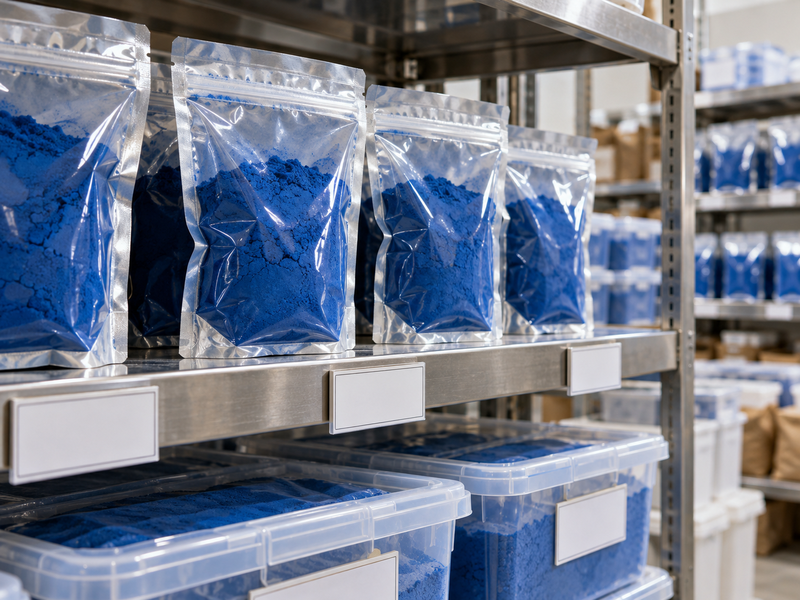
A promising blue spirulina lot can sit packed and ready while its test results, deviations or label check remain unfinished. China blue spirulina wholesale batch release is the documented decision that a named lot meets its agreed requirements before stock becomes available for dispatch. This guide turns that decision into a practical factory gate. It draws on the distinction between a defined ingredient specification and a lot record; for U.S. uses of the covered color additive, 21 CFR 73.530 provides a regulatory reference, not blanket approval for every supplier lot.
Contents
- What exactly should the release gate decide?
- Which specification and limits control a lot?
- How should samples and test results be reviewed?
- What must happen when a result is outside a limit?
- Which production and cleaning records matter?
- How are pack, label and quantity checks linked to release?
- Who has authority to release or hold stock?
- What can sales and export teams say before release?
- How should a buyer review a released batch?
- How can the gate be tested and improved?
1. What exactly should the release gate decide?
Define the decision and its boundary
Release answers a narrow question: may this identified lot move from controlled hold into saleable inventory for a specified product and customer order? It is not the same as completion of production, printing a certificate of analysis, or booking a truck. State the product code, lot code, specification revision, pack format, destination requirements and quantity covered. Where several process batches are blended, the release file should name them all.
The decisive detail: a gate has a stop state. A lot under test, under deviation review, or awaiting artwork approval remains physically and electronically blocked. Define statuses such as quarantine, under review, released and rejected so warehouse teams understand what can be picked. Record the approval time and the identity of the reviewer; a backdated signature does not protect a shipment already gone. A buyer may set an additional acceptance gate after factory release. Keep those decisions separate.

2. Which specification and limits control a lot?
Freeze the approved version before manufacture
Use the signed product specification effective for the order, not whichever PDF was last emailed. It should identify the ingredient, composition, grade, color or phycocyanin measure where relevant, moisture or other physical attributes, microbiological criteria, contaminant criteria, analytical methods and packaging conditions agreed by the parties. Each limit needs a unit and decision rule. “Pass” without a numeric result may be inadequate for a buyer’s comparison; a number without its method can also mislead. Record any customer-specific requirement that differs from the standard grade.
Link each test to the applicable market and intended use. The U.S. spirulina extract provision addresses a particular color additive and its conditions, so a team should review applicability rather than assume that a commercial name settles it. Before the run starts, quality and sales should confirm the approved revision and any order-specific limits in one written acknowledgment. If a new specification arrives while material is in process, document which lots it affects and whether additional testing or buyer approval is needed. Silent revision changes make a release decision impossible to reconstruct.
| Control item | What the gate needs | Common gap |
|---|---|---|
| Product identity | Approved grade and composition | Trade name only |
| Analytical limit | Method, unit and acceptance rule | “Pass” with no basis |
| Revision | Signed effective version | Two PDFs in circulation |
| Market condition | Agreed intended use | Assumed worldwide clearance |
3. How should samples and test results be reviewed?
Review the sample path before the number
A favorable result matters only if the sample represents the lot being shipped. Check sampling date, sampler, container or location, sample code, chain of custody and laboratory identifier. A composite sample may suit one test while targeted samples may be needed for another, depending on the written plan. State how a pack sublot or blending step affects sampling. Compare the lab’s lot code with the manufacturing record and proposed certificate of analysis.
Look one layer deeper: read actual values, methods, units, detection limits when relevant, and any analyst comments. Review instrument calibration and laboratory controls. A certificate should faithfully summarize underlying results, including failures and retests. If a method changed, ask whether results remain comparable with the contract limit. The FDA’s FSVP requirements place risk-based supplier verification duties on applicable U.S. importers; a factory COA can contribute evidence but does not transfer those importer decisions to the supplier.

4. What must happen when a result is outside a limit?
Hold first, then investigate
An out-of-specification result should block the affected stock while quality investigates. Confirm the sample identity, method execution, instrument state and any plausible laboratory error without simply retesting until a favorable number appears. Review process data and adjacent lots that may share an input or equipment run. Record whether the result reflects a true product failure, a documented test error or an unresolved case. State who may authorize each disposition: reject, rework under an approved instruction, relabel for another suitable grade, or accept only with a documented buyer concession when legally and contractually possible.
Suppose a blue color measure falls below the contracted grade. The team might assess a permitted reblend, but it must calculate composition, create a new trace and retest under an approved plan. It cannot quietly revise the COA. Suppose a microbiological limit fails. Holding the batch and reviewing connected lots takes priority over a delivery promise. Keep the record complete: original result, investigation, action, follow-up testing and final decision. Sales may discuss a replacement schedule, while factory quality retains authority over product status. A deviation closed on paper without a stock-status change leaves the gate open in practice.
| Finding | Immediate status | Evidence before disposition |
|---|---|---|
| Out-of-limit test | Hold lot and related stock | Investigation and scope |
| Missing result | Hold pending data | Valid report or approved exception |
| Method mismatch | Hold claim | Method equivalence review |
| Retest request | Preserve original result | Written rationale and plan |
5. Which production and cleaning records matter?
Connect process history to quality risk
The batch record should show material issue, equipment, processing dates, key process parameters, yields, in-process checks, operator review and any rework. Check whether all inputs were themselves approved for use. A successful finished-product test cannot explain an unknown input lot or an unrecorded blend. For a blue extract, process control can affect color and stability; assess the parameters that the manufacturer’s validated process identifies as relevant. Do not invent universal temperature or yield limits. Ask the plant to show its own approved ranges and investigate departures.
Cleaning and line-clearance records also matter when equipment handles other ingredients, carriers or grades. Review cleaning completion, inspection and release before the batch began, plus any changeover after maintenance. The practical question: can the reviewer explain every exception that occurred between weighing and sealing? If a filter change, equipment fault or unexpected pause appears, capture its quality assessment. ISO’s food-safety overview describes management systems for organizations in a food chain; a certificate can support confidence in the system, while the specific batch record must still prove that this run followed its controls.

6. How are pack, label and quantity checks linked to release?
Verify the saleable unit
Quality release must include the product the customer will receive, not just a bulk powder result. Compare pouch or drum material, seal integrity, fill weight, carton configuration, shelf-life basis, storage statement and label revision with the approved order. Check that each saleable pack displays the correct lot and product identity. Reconcile packed units, samples, rejects and remaining bulk material with the batch record. A missing quantity may signal an accounting mistake or a traceability gap; both need explanation before dispatch.
Inspect the warehouse status too. Released cartons should remain separated from held or rejected cartons and stored under agreed conditions. If a pallet is rebuilt, its new configuration and labels must stay linked to the original lot. A small but costly mistake: the COA names lot B while export cartons carry lot A because an old label roll remained on the line. Catching that at the release gate prevents document correction after loading. The International Trade Administration’s export-document guide highlights the relationship among invoice, packing list and shipment details; factory quality should provide accurate product and lot data before export staff assemble those papers.
| Pack check | Evidence | Release consequence |
|---|---|---|
| Correct code | Pack and carton inspection | Mismatch holds affected units |
| Correct revision | Approved artwork comparison | Old labels need review |
| Seal and weight | Inspection and count record | Defects segregated |
| Stock balance | Yield and warehouse reconciliation | Unexplained units investigated |
7. Who has authority to release or hold stock?
Keep approval independent of the shipping deadline
Name a trained quality function or authorized delegate in the procedure. Give that person access to the full batch file and authority to stop shipment. Production can complete records, the lab can report results, and sales can communicate delivery needs, but none should silently override a quality hold. Define a deputy for holidays and time-zone gaps. Electronic approval should capture identity, date, time, decision and specification revision. If paper is used, control signatures and prevent blank pre-signed certificates.
Ask what happens when quality and sales disagree. A written escalation route should permit discussion of data or alternatives without changing the lot status until an authorized disposition is recorded. Here is the boundary: factory release says the site permits dispatch against its criteria; a buyer’s own acceptance may still be pending. A customer may require a third-party result, approved pre-shipment sample or document review. Place that separate buyer gate on the order so sales cannot treat factory release as blanket customer consent. Reviewers need time to read the file; a deadline is a scheduling input, not a release criterion.

8. What can sales and export teams say before release?
Communicate status without promising an outcome
Sales may confirm that manufacture has finished or that testing is scheduled. It should not call a lot “approved,” issue a final COA, or book irreversible delivery steps before the status supports that statement. Export staff can draft invoice and packing details from a provisional list but should mark them pending quality release. Keep customer-facing wording aligned with the actual factory state.
If a customer needs a shipping forecast, give a conditional date and name the remaining gate. For example: “Packing is complete; microbiology review is due Thursday. Dispatch will be confirmed after quality release.” That sentence is more useful than “ready tomorrow” followed by a surprise delay. If the buyer must approve a COA, build that review time into the promise. The parties’ chosen Incoterms® 2020 rule allocates delivery costs and risks, but it does not replace an agreed product-quality release point. Specify both in the contract and shipment plan.
| Status | Sales wording | Export action |
|---|---|---|
| In process | Forecast only | Prepare draft data |
| Testing pending | State missing result | Keep booking conditional |
| Factory released | Confirm approved lot | Finalize documents |
| Buyer hold | State buyer decision pending | Do not dispatch |
9. How should a buyer review a released batch?
Check the release packet against the order
Request a concise release packet: signed COA with actual results and methods, lot genealogy, approved specification revision, pack and label confirmation, quantity, storage conditions and a summary of relevant deviations. Compare the lot on every document with cartons and the purchase order. Confirm the supplier did not substitute a different grade, plant or formulation. A buyer may ask for independent verification on selected lots, but the resulting sample must be tied to the same shipment population.
Read beyond the word “pass.” If a result sits close to a contractual limit, review method variation and previous performance with quality staff. If a deviation was closed with a concession, confirm that your authorized buyer signed it before dispatch. For a U.S. importer subject to FSVP, FDA describes risk-based verification and record review; a supplier’s internal approval does not erase importer obligations. Buyer acceptance should be a dated decision, not an assumption created when a courier collects the cartons.
10. How can the gate be tested and improved?
Review misses and run a dry exercise
Select a recent shipped lot and reconstruct its release minute by minute. Were all required results available before approval? Did warehouse status change before a pick ticket was printed? Did the COA, carton code and invoice describe one lot? Ask a second reviewer to find one missing piece, then see whether the system blocks dispatch. Record exceptions, corrective actions and ownership. This dry exercise tests the gate more honestly than counting completed forms.
Track a few useful measures: shipments before final review, document corrections after dispatch, held-lot aging, repeat deviations and customer COA queries. The numbers should help teams fix a step, not pressure reviewers into faster signatures. For your next order, ask the factory to show its release checklist for a real blue spirulina lot and walk the material from hold location to shipping authorization. Agree on the buyer’s additional acceptance point in writing. A reliable gate creates a clear yes, no or pending decision while the product is still under control.
| Gate signal | What it reveals | Improvement action |
|---|---|---|
| Late COA correction | Data or version mismatch | Reconcile before signature |
| Held lot picked | Warehouse status failure | Add physical and system block |
| Repeat deviation | Weak root-cause action | Review trend and process |
| Buyer query after dispatch | Missing shared requirement | Update release packet |
A strong release gate ties a specific lot to an approved specification, valid results, resolved exceptions and accurate saleable packs. Give quality real hold authority, then let sales and export work from the recorded decision. Ask your supplier to demonstrate one recent release before the next shipment. Both sides gain a clearer schedule when “ready” has a precise and verifiable meaning.
FAQ
Q1: Is a COA enough for batch release? No. Review the underlying lot, test, production, pack and deviation records under the approved specification.
Q2: Can a factory ship while one test is pending? Only if a written, applicable release rule and buyer agreement permit that case. Otherwise keep the lot on hold.
Q3: Who should sign the factory release? An authorized quality reviewer with access to the full file and authority to stop dispatch.
Q4: Does factory release equal buyer acceptance? No. The buyer may have a separate contractual or regulatory verification step.
Q5: What if a finished result fails? Hold affected stock, investigate the original result and document a permitted disposition before any new release.