
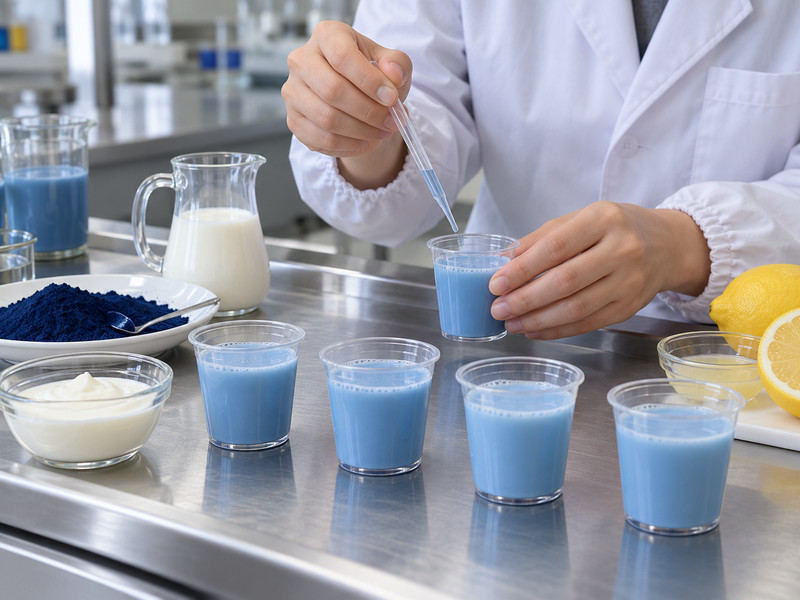
Blue spirulina is often described as mild, yet that generalization is not a sensory specification. Taste depends on the material, the amount used, its carrier, and the beverage or food around it. Product developers should judge blue spirulina flavor in a blinded test of the finished formula and repeat it after the normal process and storage interval.
1. What does blue spirulina flavor actually mean?
The name may refer to an extracted blue fraction, a blend, or a whole-biomass ingredient
Whole green spirulina commonly gives a stronger vegetal impression, while an extract may be milder; neither description should replace a test of the exact grade.
Put a sample next to its paperwork before making a decision. Record the supplier’s exact grade name, ingredient statement, lot number, and the intended technical function in the finished product. Ask whether the material is whole biomass, a phycocyanin-rich extract, or a formulated preparation. This distinction changes the likely shade, dose, flavor, and label. If a specification says only ‘blue spirulina’ without an assay method or composition, send it back for clarification. The procurement record should make sense to someone who did not attend the original sales call.
Use the exact extract grade and carrier in every sensory comparison. A supplier can change powder composition without changing the broad blue-spirulina name.
2. Can a dry-powder taste test predict the product?
No useful sensory decision comes from tasting powder alone
Hydration, acidity, sweetness, fat, and aroma change perception. Make a control formula and a dose series, then evaluate at serving temperature after the normal processing steps.
Write the product brief in terms of a real consumer unit: a drink after filling, a candy after wrapping, or a cosmetic after its stability interval. Include recipe pH, processing temperature, holding time, background color, package, shelf life, market, and target price. These numbers and constraints let a supplier recommend a sensible grade. Without them, two seemingly identical samples may be tested under completely different conditions. Keep a small uncolored batch as a control; it helps distinguish pigment behavior from changes in the base recipe.
Keep the panel blind to brand and expected results. Descriptive notes are more useful than a simple like/dislike score when diagnosing an off-note.
| Decision point | Evidence to retain | Decision or check |
|---|---|---|
| Can a dry-powder taste test predict the product | Source and composition file | Does the chosen material fit this recipe? |
| Which off-notes should a panel record | Formula revision and pH record | Was the target matrix actually tested? |
| Changed recipe | Dated decision and retained record | Retest shade and sensory |
3. Which off-notes should a panel record?
Ask panelists to describe marine, earthy, grassy, bitter, or stale notes in their own words before showing supplier descriptors
Record both onset and aftertaste. A difference that seems slight in a sweet smoothie can dominate a clear drink.
A certificate of analysis is useful only when its methods, limits, units, and lot number can be understood. Ask how the blue fraction is assayed and whether a reported value refers to the pigment, total protein, or another basis. Verify moisture, microbial, and relevant contaminant results against the risk assessment for the intended use. If the supplier uses a code such as E3 or E40, request the actual specification rather than interpreting the code as a concentration or purity percentage. Compare like with like across candidates.
Record whether panelists assess the dry aroma, prepared product, or aftertaste. These are different measurements and should not be pooled.
4. How does use level change the tradeoff?
Increase dosage until the desired color is reached, then test flavor at that practical point
Comparing samples at equal powder mass can mislead when pigment strength differs. Report color and sensory findings together so the team sees the real tradeoff.
Build a bench trial that isolates the ingredient from other changes. Use one base batch, weigh the addition accurately, and change only one variable per sample. Photograph it with a neutral color reference under fixed lighting and record the dose per finished serving. Taste and physical stability need their own observations. A supplier’s recommended dosage is a starting range, not a validated addition rate for every formula. The final decision should be made after the ingredient goes through the actual production sequence.
Prepare control and test samples at the same temperature and age. Recipe differences can masquerade as an ingredient flavor difference.
| Decision point | Evidence to retain | Decision or check |
|---|---|---|
| How does use level change the tradeoff | Dose ladder and color reference | Was the target reached at a viable dose? |
| Can acid or sweetener conceal an unwanted note | Process temperature and time log | Did the result survive manufacturing? |
| Changed process | Dated decision and retained record | Repeat the color trial |
5. Can acid or sweetener conceal an unwanted note?
Acid, sweeteners, and fruit flavor can alter perception, but each also changes cost and potentially color stability
Run controlled trials with one variable at a time. A successful masked sample should be retested after storage, when aroma can drift.
The published review of phycocyanin stability describes sensitivity to conditions such as temperature, pH, and light. It is valuable for choosing stress conditions, yet it cannot predict the exact shelf life of a proprietary recipe. Measure the finished item at defined time points in its final package. Include realistic transport and retail exposure where relevant. Log visual shade and an instrument reading if available; neither alone captures taste, microbial quality, or physical separation.
Repeat the tasting after process heat and storage. An odor that is absent at day zero can appear later in the commercial package.
6. What does processing do to aroma?
Heat, oxygen exposure, and storage can change an extract or the surrounding formula
Use the production sequence and package in the trial. Evaluate fresh and aged samples in blind order, rather than letting panelists compare only freshly mixed cups.
Sensory and operations staff should participate early, not after the color has been approved. Note off-odor, aftertaste, sediment, line residue, filtration loss, and cleanability in the trial sheet. A small laboratory sample can hide a problem that becomes expensive at plant scale. If a change to the carrier or addition point solves one problem, repeat the color and safety checks. Calculate total cost per acceptable finished unit, including waste and testing, instead of using the quoted powder price as the sole comparison.
Compare color target and acceptable flavor at the same dose. A milder low-dose sample is irrelevant if it fails the visual brief.
| Decision point | Evidence to retain | Decision or check |
|---|---|---|
| What does processing do to aroma | Blind sensory panel and reference | Is the finished product acceptable? |
| Which supplier details help explain flavor differences | Current-lot COA and risk plan | Can the lot be released safely? |
| Changed carrier | Dated decision and retained record | Repeat sensory and label review |
7. Which supplier details help explain flavor differences?
Request carrier disclosure, extraction route, residual moisture, packaging, and shelf-life conditions
Retain lot samples when a flavor complaint occurs. A process or raw-material change can create a sensory shift without a large change in basic assay.
Quality release begins with traceability. Obtain a current-lot COA, agreed specification, and enough source information to confirm the preparation is the one tested. The FDA’s discussion of microcystins explains why contamination controls matter for blue-green-algae products. Decide which hazards require every-lot testing and which are controlled through a verified monitoring plan. A vivid color does not demonstrate absence of unwanted microorganisms, toxins, or elemental contaminants.
Quality records should cover oxidation, moisture, and storage conditions when flavor complaints emerge. Sensory drift can reflect handling rather than recipe alone.
8. Are flavor claims regulated?
“Tasteless” and “no algae taste” are broad claims that can be challenged by finished-product data
Advertising and labeling review should use the exact commercial material and dose. Do not convert a small panel result into a universal product promise.
The regulatory reviewer needs the exact ingredient, technical function, food or cosmetic category, intended market, and proposed label. For US food-color uses, read the current FDA order on spirulina extract, including its exceptions and specifications. A color authorization is not a permission for a health claim. Different countries can classify the same material differently. Keep the decision dated and tied to the approved formula so future ingredient changes trigger review.
Review “neutral flavor” language against the tested application. A statement true in one smoothie may be misleading in a clear, unsweetened drink.
| Decision point | Evidence to retain | Decision or check |
|---|---|---|
| Are flavor claims regulated | Market-specific rule review | Is this use covered by current rules? |
| What is a practical sensory acceptance test | Approved label and full composition | Does the declaration match the grade? |
| Changed destination market | Dated decision and retained record | Recheck permitted use |
9. What is a practical sensory acceptance test?
Use a blinded panel with defined preparation, serving temperature, reference samples, and descriptive scores
Repeat on at least a second ingredient lot before fixing a specification. Keep the raw comments, not only the average score.
A pilot trial should answer a purchase question rather than merely make an attractive photograph. Define an acceptable color range, a maximum off-note, a physical-stability limit, and the sampling schedule before starting. Use the planned equipment and package, and retain samples from the tested ingredient lot. Compare against an uncolored control and, if possible, the current commercial benchmark. If a sample fails, record whether the failure came from the material, process, or finished-food matrix before changing suppliers.
Write a rejection threshold for specific notes before seeing results. This makes supplier comparisons less vulnerable to preference for a familiar brand.
10. How can a brand brief a supplier?
Send the proposed recipe category, target shade, maximum dose, processing conditions, and unacceptable notes
Ask for a suitable sample and matching technical file. A supplier can recommend a grade more effectively when the sensory limit is stated.
Make the final decision against written criteria: technical performance, legal fit, supplier records, capacity, change control, and cost at the use level that passes the shelf-life test. Ask for advance notice of changes to source, carrier, site, or process. Keep the approved sample and its analytical file available to receiving and quality teams. This prevents a future shipment with the same marketing name but different formulation from being treated as automatically equivalent. A small qualification effort now can avoid a much larger recall or rework later.
Keep raw panel sheets and the lot numbers. They are the evidence needed if a later shipment tastes different from the approved sample.
| Decision point | Evidence to retain | Decision or check |
|---|---|---|
| How can a brand brief a supplier | Pilot and shelf-life report | Can production repeat the result? |
| How can a brand brief a supplier | Signed specification and change notice | Will future lots remain equivalent? |
| Changed supplier | Dated decision and retained record | Requalify the new lot |
Five quick questions about blue spirulina flavor
What does blue spirulina flavor actually mean? The name may refer to an extracted blue fraction, a blend, or a whole-biomass ingredient. Whole green spirulina commonly gives a stronger vegetal impression, while an extract may be milder; neither description should replace a test of the exact grade.
Can a dry-powder taste test predict the product? No useful sensory decision comes from tasting powder alone. Hydration, acidity, sweetness, fat, and aroma change perception.
Which off-notes should a panel record? Ask panelists to describe marine, earthy, grassy, bitter, or stale notes in their own words before showing supplier descriptors. Record both onset and aftertaste.
How does use level change the tradeoff? Increase dosage until the desired color is reached, then test flavor at that practical point. Comparing samples at equal powder mass can mislead when pigment strength differs.
Can acid or sweetener conceal an unwanted note? Acid, sweeteners, and fruit flavor can alter perception, but each also changes cost and potentially color stability. Run controlled trials with one variable at a time.
A practical next step
For a blue spirulina flavor project, send the target application, process, destination market, and requested documentation to the ingredient supplier. Ask for a current-lot sample and technical file, then qualify the material in the finished product before approving copy or a purchase order. Review our spirulina and blue extract powder range and request the specific grade information needed for your formula.