
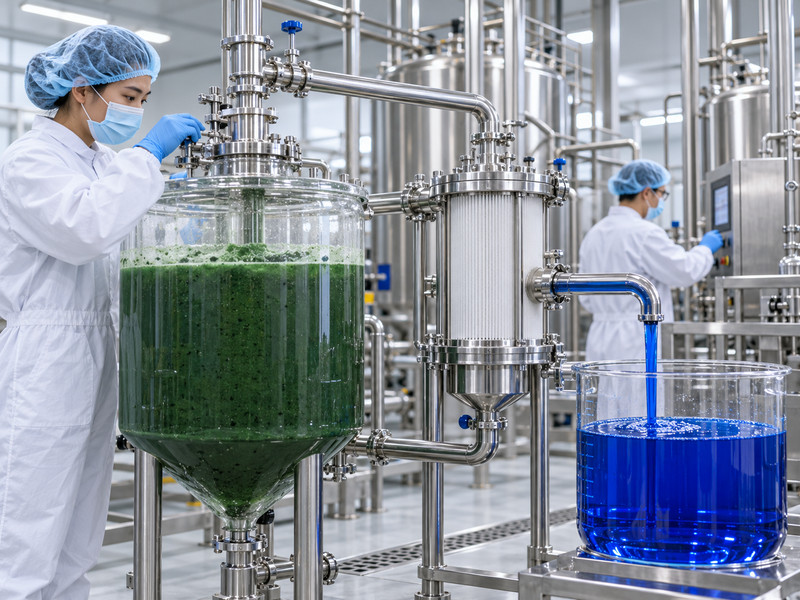
The blue spirulina extraction process is a sequence of controlled choices, not a single recipe. Cultivation quality affects the starting biomass; disruption and separation affect yield and impurities; drying and packaging affect the blue powder’s stability. Buyers do not need a supplier’s trade secrets, but they do need enough process information to judge identity, repeatability, and risk. A useful process review follows one traceable lot from harvested biomass to packed powder, noting where contamination can enter and where pigment loss can occur. It asks which measurements release an intermediate to the next step and who investigates a deviation. Those details tell a buyer more about commercial consistency than a photograph of stainless-steel equipment. The retained lot sample should match the records used for approval.
1. Where does the blue spirulina extraction process begin?
It begins with cultivated spirulina biomass of documented origin
Harvest timing and raw-material quality influence the extract. A process flow should identify the source organism and the controls before extraction.
A product name is not a compositional analysis. Start with a full ingredient statement, source organism, source site, manufacturing site, and a process summary. Put the proposed use beside that identity: a food color, a supplement component, and a cosmetic ingredient can face different requirements. Ask whether the blue fraction is isolated, concentrated, or blended with a carrier. Whole green spirulina powder should be listed separately. The record should allow another reviewer to trace a shipped lot back to the material that was approved.
Ask where each process step occurs and which lot code connects it to the next step.
2. How are cells opened?
Processors may use mechanical or other controlled disruption methods to release water-soluble pigment
Ask which broad method is used and how temperature and time are controlled. Excessive processing can affect protein structure and color.
Clarify the question before comparing documents. Is the buyer trying to identify the biological source, understand processing, support an organic claim, or qualify an application? Each needs a different record. A photo of cultivation ponds can illustrate origin, but it does not establish species, site, certification, or batch traceability. Request a process-flow document at an appropriate level of detail and reconcile the names on it with the label, invoice, and certificate of analysis. Unresolved inconsistencies should hold approval.
A process diagram without temperature and time controls at critical points leaves consistency unexplained.
| Decision point | Evidence to retain | Decision or check |
|---|---|---|
| How are cells opened | Source and process-flow record | Is the organism and origin traceable? |
| Why is water commonly involved | Full composition and carrier list | Does the shipped grade match the file? |
| Changed source | Dated decision and retained record | Recheck traceability |
3. Why is water commonly involved?
Phycocyanin is water soluble, so aqueous extraction is a common route in research and industry
The exact solution, ratio, and conditions vary. Confirm whether processing aids are used and how they are removed or declared.
Define analytical terms in the specification. A reported pigment figure needs a method, reference basis, and units. Moisture, color, microbiological limits, and any relevant contaminants also need methods and acceptance criteria. A grade code by itself does not tell the buyer the percentage of phycocyanin or the legal identity. Ask for recent lot data to see normal variation, not only a target value. Retain a sample from the qualified lot so a later change in appearance can be investigated rather than argued from memory.
Methods for pigment assay should be stable across process changes so trend data remain comparable.
4. What does clarification remove?
Clarification separates insoluble biomass from a colored liquid fraction
Filtration and centrifugation choices affect yield, clarity, and microbial control. Buyers should ask how the processor verifies the target fraction and controls unwanted residues.
The review of spirulina cultivation and extraction describes multiple ways of obtaining valuable fractions from biomass. It is a map of possibilities, not a process disclosure for a particular supplier. Ask which broad stages apply to the offered grade and what controls protect quality at each handoff. Changes in extraction, separation, drying, or carriers can alter the final material even when the organism stays the same. Keep proprietary settings out of the commercial article, but require enough information for safety and legal review.
Clarification and separation affect not only color but also the constituents carried into the final preparation.
| Decision point | Evidence to retain | Decision or check |
|---|---|---|
| What does clarification remove | Assay method and reporting basis | Can these grade figures be compared? |
| How is the extract concentrated | Process-stage controls | Are critical steps documented? |
| Changed assay | Dated decision and retained record | Rebaseline lot trends |
5. How is the extract concentrated?
Concentration can reduce water before final drying or other handling
Heat exposure and hold time matter. A supplier’s process specification should describe controls and critical quality tests without exposing proprietary settings.
A blue powder can fade or behave differently after moisture and heat exposure. Phycocyanin stability research points to pH, light, and temperature as test variables. Confirm how the supplier packages the material, its stated storage conditions, and the basis of its shelf life. Then test the ingredient in the buyer’s intended matrix. A shelf-life statement for unopened powder cannot guarantee identical performance after dispersion into an acidic drink or a heated confection.
Drying and packaging should be evaluated together because moisture gain after drying can undo earlier controls.
6. Why does drying method matter?
Drying converts the extract to a transportable powder but can influence color, moisture, particle behavior, and need for a carrier
Compare the exact supplied form. A wet intermediate is not a finished powder specification.
Commercial comparisons should normalize to a relevant result. Price per kilogram is less useful than cost per unit of verified color or per acceptable finished product. Carrier content, concentration method, and transport conditions can change that figure. Ask how the supplier handles out-of-spec lots and whether it will notify customers about a source or process change. The goal is repeatable production, not the brightest first sample. Document the reason for selection so purchasing can protect it when prices change.
Yield should be balanced against stability and microbiological control, not maximized in isolation.
| Decision point | Evidence to retain | Decision or check |
|---|---|---|
| Why does drying method matter | Storage and moisture specification | Will this lot remain stable? |
| Which tests show process consistency | Lot-linked COA and test methods | Do results meet agreed limits? |
| Changed package | Dated decision and retained record | Repeat stability review |
7. Which tests show process consistency?
Track pigment assay by a defined method, moisture, color, microbiology, and relevant contaminants across lots
Trend results over time. A single excellent sample does not prove a stable process.
Risk assessment is tied to source and use. The FDA notes microcystin concerns for blue-green algae products. Request the supplier’s lot-linked testing approach for relevant toxins, microbial quality, and elemental contaminants, then compare it with the destination market and application. A clean certificate for one lot is useful evidence but not proof that the overall process is controlled. Review trends, deviations, and corrective actions when the ingredient is strategic.
A risk-based testing plan verifies that process controls are working on commercial lots.
8. How do safety and regulatory requirements fit?
Food-color rules can define identity and specifications in the destination market
The supplier’s controls should support those requirements as well as internal risk assessment. Review changes in the applicable US rule, including the 2026 update.
Legal review needs to connect the identity on the specification to the identity in the applicable rule. The 2026 FDA spirulina-extract final order is relevant to US food-color uses, with conditions and exceptions. It does not settle organic status, cosmetic suitability, or human health claims. Other markets require their own assessment. Save the exact rule version and reviewer decision with the approved grade, rather than attaching a general web page to every product indiscriminately.
Regulatory identity can limit what process or ingredients qualify for a particular destination-market use.
| Decision point | Evidence to retain | Decision or check |
|---|---|---|
| How do safety and regulatory requirements fit | Current market rule and identity | Does this preparation fit the listing? |
| What should a process audit ask | Approved use and label decision | Is the application covered? |
| Changed use | Dated decision and retained record | Repeat legal review |
9. What should a process audit ask?
Look at traceability, water control, cleaning, equipment maintenance, process deviations, test methods, and change control
Ask how rejected lots are handled. A flowchart is useful, but records show whether it is followed.
An effective verification exercise starts with a sealed sample whose lot number matches the COA. Compare the material with the agreed reference in appearance, assay, dispersion, and any safety-critical tests selected by the risk assessment. Keep the sample and raw observations. If analytical results disagree, review methods and sample preparation before concluding that one party is wrong. A brochure is useful for orientation, but a reproducible lot evaluation is what supports approval of a purchase specification.
Audit deviations and rejected lots to learn more than a showroom tour can reveal.
10. Which process details belong in a contract?
Specify material identity, broad extraction route, permitted carriers, quality limits, site, packaging, and change-notification triggers
This lets a buyer protect product consistency without demanding the supplier’s proprietary recipe.
The purchase specification should be concrete enough for receiving, quality, and regulatory teams to use without interpretation. Include identity, source, carrier, methods, limits, package, storage, shelf life, traceability, and change notification. Record the approved use and market separately; those may change without altering the ingredient. Requalify after a material change. A technically accurate product name is a beginning, but the controlled file makes it operational across repeated shipments.
Write change-notification triggers into the supply contract before the commercial process evolves.
| Decision point | Evidence to retain | Decision or check |
|---|---|---|
| Which process details belong in a contract | Retained sample and independent check | Does delivery match the approved grade? |
| Which process details belong in a contract | Signed purchase specification | Are change triggers explicit? |
| Changed process | Dated decision and retained record | Requalify the material |
Five quick questions about blue spirulina extraction process
Where does the blue spirulina extraction process begin? It begins with cultivated spirulina biomass of documented origin. Harvest timing and raw-material quality influence the extract.
How are cells opened? Processors may use mechanical or other controlled disruption methods to release water-soluble pigment. Ask which broad method is used and how temperature and time are controlled.
Why is water commonly involved? Phycocyanin is water soluble, so aqueous extraction is a common route in research and industry. The exact solution, ratio, and conditions vary.
What does clarification remove? Clarification separates insoluble biomass from a colored liquid fraction. Filtration and centrifugation choices affect yield, clarity, and microbial control.
How is the extract concentrated? Concentration can reduce water before final drying or other handling. Heat exposure and hold time matter.
A practical next step
For a blue spirulina extraction process project, send the target application, process, destination market, and requested documentation to the ingredient supplier. Ask for a current-lot sample and technical file, then qualify the material in the finished product before approving copy or a purchase order. Review our spirulina and blue extract powder range and request the specific grade information needed for your formula.