
Blue spirulina customs clearance starts before shipment reaches a US port. The buyer needs to know what is in the powder, its intended use, the importer, and whether documents describe the same product. “Blue spirulina” can mean an extracted pigment, a powder with carriers, or a loose marketing term.
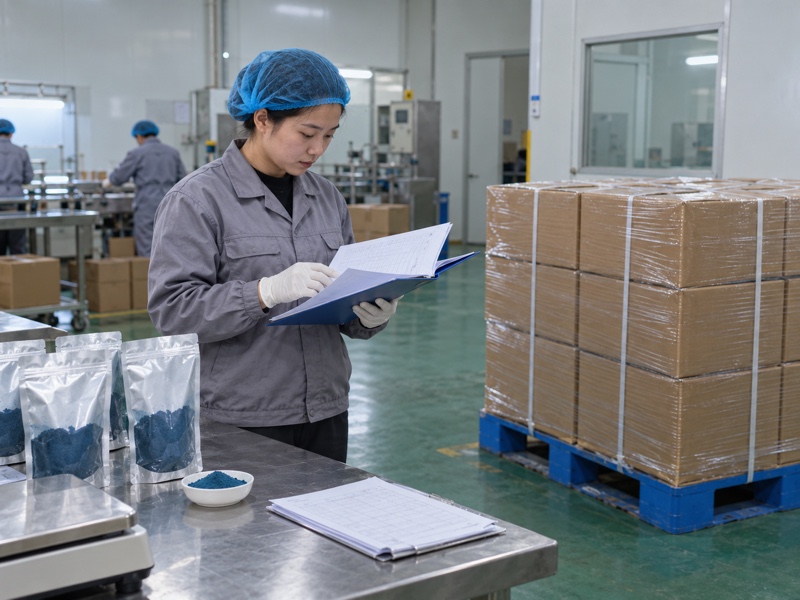
This guide maps the decisions US food ingredient buyers should settle before dispatch from a mainland China supplier. Tariff treatment depends on the actual formula, processing, intended use, and rules in force at entry.
1. What product is actually crossing the border?
Define the exact imported material
Start with a technical identity sheet, not the sales name on a quotation. Ask whether the material is whole dried spirulina biomass, an extracted phycocyanin preparation, or a blend made with a carrier or stabilizer. Identify the scientific source, extraction steps, ingredient percentages or ranges, and the physical form shipped. A single-word product description cannot tell a broker whether a shipment is biomass, extract, or a formulated preparation.
Our catalog lists blue spirulina/phycocyanin powders under E3, E6, E18, E25, E35, and E40 grade names, as well as whole spirulina and chlorella products. Those labels alone do not establish composition, tariff classification, permitted use, or a particular manufacturing method. Request the current specification and lot certificate of analysis (COA) for the exact grade and order. Match the product name and batch identifier across the quotation, invoice, packing list, COA, and shipping labels.
| Identity question | Record to request | Why the importer needs it |
|---|---|---|
| Is it whole biomass or an extract? | Process description and product specification | Processing can change the classification analysis. |
| What else is in the powder? | Formula or ingredient range, including carriers | A prepared blend cannot be assessed from pigment name alone. |
| What form is shipped? | Powder specification, pack size, and labels | Physical description should match entry documents. |
| Which lot is supplied? | Lot COA and packing trace | Supports document matching and later investigation. |
Give the broker the technical description before choosing a tariff heading.
2. Why does the CBP Spirulina Blue ruling matter?
Read the ruling in context
US Customs and Border Protection (CBP) ruling HQ H324168, dated August 26, 2022, is a useful illustration of fact-specific classification. It concerns a China-made product called CA2786 Spirulina Blue Colour, described as spirulina extract/phycocyanin with trehalose and sodium citrate. CBP examined the extraction and formulation facts and classified that particular merchandise under the tariff provision stated in the ruling. CBP also explained why several alternative headings did not describe that merchandise.
The ruling does not classify every commercial “blue spirulina” grade. It refers to a defined formula and a tariff schedule in effect for that decision. The duty rate printed in an older ruling is not a current-rate promise. A buyer who pastes its number onto a different extract, biomass, or blend could create an avoidable entry problem. Read the ruling as an example of the evidence CBP examined, then prepare the same level of detail for your own product.
| H324168 fact | What to verify for your order |
|---|---|
| A named China-made color preparation | Actual producer, country of origin, and product name |
| Extracted phycocyanin plus other ingredients | Current formula, including all carriers and stabilizers |
| Specific extraction and preparation facts | Your supplier's actual process description |
| Classification under the schedule applied to that ruling | Current US tariff text and product-specific advice |
If uncertainty remains, discuss a prospective binding ruling request with a customs specialist. CBP's electronic ruling portal accepts requests containing the complete material facts.
3. Who should confirm the current tariff treatment?
Document the classification decision
The importer of record, assisted by its broker or trade counsel, should make a documented classification decision for the goods being entered. The China supplier can provide manufacturing and composition evidence; it cannot turn an old ruling into a universal tariff code. Request a written rationale that identifies the actual product, applicable tariff edition, relevant chapter notes, and any product-specific ruling. The USITC Harmonized Tariff Schedule is the place to check the current US schedule. Its revisions matter because descriptions and duty rates can change.
At quotation stage, use a provisional classification estimate with explicit assumptions. Before dispatch, verify the final formula and origin with the broker. Reopen the analysis if a carrier, process, or intended use changes.
For a complex preparation, a CBP binding ruling request can ask CBP to decide how the described merchandise is treated. The request should accurately disclose the formula, process, and proposed transaction. Do not selectively omit a carrier simply because its presence makes the decision harder. Keep the ruling response with the purchasing specification so the shipment team can verify that later lots still match the ruled article.
4. Which commercial documents must agree before booking?
Reconcile product and shipment records
A clean entry begins with consistent records. CBP says a commercial invoice should give an adequate description, quantity, value, and tariff information. CBP's formal entry guidance also identifies shipping documents and, where available, a packing list. The broker may request additional records depending on the product and entry. Ask for draft documents while the supplier can still correct them.
The invoice should identify the parties, goods, quantity, price, currency, and transaction terms. The packing list should show carton count, weights, and lot allocation. If several grades share one container, use line-level descriptions and lot mapping. The COA does not replace an invoice or determine customs value.
| Document | Cross-check before dispatch | Frequent problem |
|---|---|---|
| Commercial invoice | Actual product identity, parties, quantity, value, terms | Marketing name only; mismatched quantity |
| Packing list | Cartons, weights, grade and lot mapping | Lots mixed with no carton trace |
| Transport document | Consignee, destination, package count | Different party or package count |
| Specification and COA | Formula identity, grade, test results, lot | Generic specification used for a different batch |
| Origin statement and labels | Actual production origin and markings | Assumption based on seller address |
The broker, forwarder, and supplier should work from the same approved invoice and packing list.
5. How should customs value and origin be checked?
Review origin and valuation evidence
The invoice price is the starting point for an import value review, not always the whole calculation. CBP's valuation guidance describes the price paid or payable and specified additions that may apply. Ask the broker to review the real purchase contract, assists, packaging, royalties, and other potentially relevant terms. Do not substitute a retail resale price for the commercial transaction or quietly omit a separate payment that belongs in the valuation analysis.
Country of origin also needs evidence. The exporter’s location or dispatch port alone does not prove where the article originated. Ask who cultivated the biomass, where extraction and blending happened, and what transformations took place before packing. Record the manufacturing site that made the shipped product and have a specialist assess any multi-country processing. The documents and markings should reflect the resulting origin decision. Do not put “Made in China” on a product merely because it was shipped from China; equally, do not remove a China origin statement because an intermediary issued the invoice elsewhere.
For landed-cost planning, document the exchange rate, freight treatment, tariff assumption, and any trade measures reviewed by the broker.
6. What FDA checks run alongside the CBP entry?
Prepare the FDA entry file
Customs classification and US food regulation answer different questions. A tariff heading says how a product is treated for customs purposes; it does not authorize every intended food use. FDA explains that imported human food must meet applicable US requirements. An importer should identify the actual use: color additive, ingredient in a food, dietary supplement component, or another purpose. That choice affects the regulatory review and the information requested from the supplier.
For an intended color use, compare the exact substance and application with FDA's current spirulina extract color additive entry and the controlling regulation, 21 CFR 73.530. Review permitted uses and specifications as they stand at the time of sale. A customs ruling that calls a preparation something other than coloring matter for tariff purposes does not settle FDA color-additive status. Nor does a supplier's statement that a powder is “food grade” establish that a proposed US application is permitted.
FDA's prior notice guidance explains that imported food generally requires prior notice before arrival, subject to exceptions. The importer should also assess whether the Foreign Supplier Verification Programs rule applies to its role and product. Put the responsible US party, FDA facility and food description information, and filing deadlines on the shipment checklist. A customs broker may help transmit data, but the buyer should still verify that the underlying product description is right.
7. Which supplier evidence makes a blue powder easier to review?
Make the technical dossier traceable
Ask for an evidence pack built around the ordered grade and lot. A product specification should name the ingredient, composition or relevant ingredient ranges, appearance, intended storage, and appropriate acceptance criteria. The COA should show the actual batch and test results, not just a blank template. Ask how identity and color strength were tested, which method was used, and whether the numerical result is on a dry or as-sold basis. Where a carrier is present, identify it explicitly.
Food safety records should be proportionate to the use and supplier risk assessment. Depending on product and application, buyers may ask for microbiological results, contaminants, allergen information, traceability, and manufacturing controls. Do not treat a single COA as a complete supplier audit. Check whether the test lab, sampling point, method, and date are usable for the buyer's own quality program. If a document gives a “pass” without a limit or method, ask what standard was actually applied.
Request packaging and storage instructions backed by the supplier's evidence. For a pilot order, retain a reference sample tied to the imported lot so color, dispersibility, and identity can be compared after arrival.
8. When should the broker and supplier receive the dossier?
Sequence the pre-shipment review
Share the first technical dossier while negotiating the sample or first commercial order. That gives the broker time to flag ambiguous composition, a possible ruling question, FDA data gaps, or an origin issue. By the purchase order stage, agree on the product name and document wording. Before cargo booking, send final draft invoice and packing list to the importer and broker. Before the goods depart, confirm that the final formula and lot match the reviewed dossier.
| Gate | Buyer decision | Evidence to freeze |
|---|---|---|
| Sample approval | Does the tested material match the proposed grade? | Sample ID, specification, intended use |
| Purchase order | Are price, Incoterms, importer, and document owners clear? | Contract and technical annex |
| Before booking | Is classification and FDA review complete enough to ship? | Formula, origin, broker review |
| Before departure | Do invoice, packing list, labels, and COA match? | Final signed document set |
| Before arrival | Have required filings been submitted and checked? | Filing confirmations and shipment updates |
If the carrier, extraction method, or manufacturing plant changes after broker review, recheck the tariff and regulatory analysis before shipping.
9. What should a first shipment pilot prove?
Test the entry workflow
A pilot import should test both product performance and document discipline. Ask the supplier to ship a representative lot in the intended commercial packaging, with the same invoice wording and quality documents expected at scale. The US receiving team should record arrival condition, seal and carton integrity, batch numbers, storage temperature if monitored, and any visible moisture or damage. Compare the received material with the retained pre-shipment sample under the same test method.
Track customs and FDA questions raised during the pilot: vague descriptions, missing composition, inconsistent origin, or late prior notice data. Revise the purchase specification and document templates before recurring orders.
Give procurement, quality, and the broker a shared product identifier connecting each carton to its lot and entry.
10. What final questions should an importer ask before release?
Close outstanding release questions
Use a final check that can be answered from the approved file, rather than memory. For blue spirulina customs clearance, the key outcome is a defensible description of the exact shipped merchandise and a record that the required entry and food checks were addressed for its intended use. If the answer to a question changes, update the entry instructions before goods arrive.
| Final question | Acceptable evidence |
|---|---|
| What is the shipped material? | Approved formula, process summary, specification, lot COA |
| What tariff treatment is used? | Current schedule review and broker rationale or applicable ruling |
| What is its origin and value? | Production history, invoice, contract, valuation review |
| Are food requirements addressed? | Intended-use assessment and relevant FDA filing records |
| Can the lot be traced? | Carton map, batch number, retained sample and receiving record |
FAQ 1: Does every blue spirulina powder use the code in H324168?
No. CBP decided the treatment of the specific preparation described in that ruling under the tariff schedule relevant to that decision. Different formulas and manufacturing facts require their own analysis against the current schedule.
FAQ 2: Can the supplier choose the US tariff code on the invoice?
The supplier can provide composition and process facts and may propose a code. The importer of record should review the code with its broker or adviser before entry and keep the rationale with the shipment file.
FAQ 3: Is a lot COA enough for FDA and customs clearance?
No. A COA supports batch quality and identity, but invoice, packing, transport, origin, value, intended-use, and applicable FDA information serve different purposes. The required set depends on the transaction.
FAQ 4: Does a CBP color-related classification decide FDA color-additive legality?
No. CBP classification and FDA use restrictions are separate analyses. Check the current FDA regulation for the actual substance and intended application before commercial use.
FAQ 5: When should a buyer ask for a binding ruling?
Consider it before a prospective import when material facts leave genuine classification uncertainty after specialist review. The request should disclose the exact product and process; a ruling on a different formulation is not a shortcut.
Send the intended US use, target grade, shipment format, and document questions with the sample request.